



























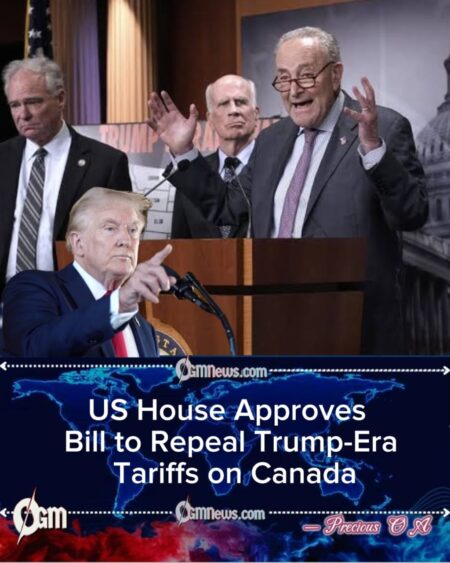
US House lawmakers approved legislation aimed at ending tariffs imposed on Canadian imports during President Donald Trump’s administration, marking a significant development in the ongoing debate over trade policy and executive authority. The bill, which passed after extended floor debate, seeks to reverse duties that critics argue have strained economic ties between the two longtime allies.
US House supporters of the measure framed it as an effort to restore stability to cross-border trade, particularly in sectors such as steel, aluminum, agriculture, and manufacturing. They argued that while tariffs were initially justified under national security provisions, their prolonged use has had downstream effects on supply chains and consumer prices.
US House opponents, however, cautioned that removing tariffs without broader concessions could weaken U.S. leverage in trade negotiations. They maintained that protective measures were originally enacted to counter unfair trade practices and preserve domestic industries.
Background of the Tariff Dispute
The tariffs in question were introduced under Section 232 of
the Trade Expansion Act, which allows the executive branch to impose trade restrictions on national security grounds. At the time, the administration argued that certain imports threatened domestic production capacity critical to U.S. security.
US House debate revisited whether Canada — a NATO ally and major trading partner — met the threshold of posing such a threat. Many lawmakers expressed skepticism, noting the deeply integrated nature of the North American supply chain.
Economists have long debated the impact of these tariffs. Some studies suggest they provided limited relief to targeted domestic industries, while others indicate they contributed to higher costs for manufacturers reliant on imported inputs.
US House Trade Debate Reflects Broader Policy Divide
US House discussions underscored a broader philosophical divide over the role of tariffs in U.S. economic strategy. Some members argued that tariffs can serve as legitimate negotiating tools, while others described them as blunt instruments that distort markets.
US House proponents of repeal emphasized the importance of predictable trade relationships with Canada, the United States’ largest goods trading partner. They argued that uncertainty can discourage investment and complicate long-term planning for businesses operating on both sides of the border.
The debate also touched on congressional authority in trade matters. Although the Constitution grants Congress the power to regulate commerce with foreign nations, much of that authority has been delegated to the executive branch over time.
Economic and Diplomatic Implications
US House members in favor of the bill pointed to potential economic benefits, including reduced input costs for manufacturers and greater price stability for consumers. Agricultural exporters in particular have advocated for fewer trade barriers to ensure competitive access to Canadian markets.
US House critics warned that eliminating tariffs without reciprocal policy adjustments could reduce negotiating leverage in future trade disputes. They argued that tariffs, when used strategically, can secure commitments related to labor standards or market access.
Diplomatically, the vote sends a signal regarding congressional intent to recalibrate trade relations with close allies. Canada has previously responded to U.S. tariffs with retaliatory measures, affecting industries ranging from dairy to industrial goods.
Next Steps and Legislative Outlook
The legislation now faces consideration in the Senate, where its prospects remain uncertain. Even if approved by both chambers, questions remain about potential executive responses, including the possibility of a veto.
Trade policy often reflects a balance between domestic political pressures and international economic realities. Lawmakers must weigh the interests of specific industries against broader macroeconomic outcomes.
Observers note that trade debates rarely produce uniform consensus. Instead, they expose competing priorities: protecting domestic production, maintaining strategic leverage, preserving consumer affordability, and sustaining diplomatic relationships.
Broader Context of U.S.–Canada Trade
The United States and Canada share one of the world’s most extensive bilateral trade relationships, governed in part by the United States–Mexico–Canada Agreement (USMCA). Supply chains in automotive, energy, agriculture, and manufacturing sectors are deeply interconnected.
Adjustments to tariff policy can ripple across these industries, affecting employment, pricing, and investment decisions. Business groups have often called for clarity and predictability in trade rules to minimize disruption.
The House vote reflects an ongoing reassessment of how tariffs should be used in contemporary trade strategy. Whether the measure ultimately becomes law will depend on further legislative action and executive considerations, but the debate itself highlights enduring tensions over economic policy, authority, and alliance management.

[…] […]