






















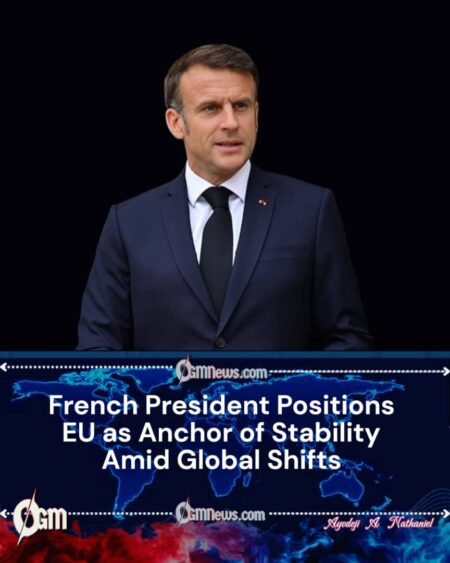
French President Emmanuel Macron has offered a candid assessment of the current global order, describing China as “an authoritarian regime” while characterizing the United States as becoming “an unpredictable economy and governance” environment for companies and, at times, for countries. In contrast, he positioned the European Union as a bloc grounded in rule of law and institutional predictability.
Macron’s remarks reflect ongoing European efforts to define the EU’s strategic identity amid shifting geopolitical and economic dynamics.
China: “A Collective Choice” Toward Authoritarianism
In addressing China, Macron stated plainly that it is an authoritarian regime, adding that this political structure is the result of a “collective choice.” His phrasing appeared designed to acknowledge China’s governance model without framing it as accidental or transitional.
The comment aligns with broader European Union policy, which often describes China simultaneously as a partner, competitor, and systemic rival. European leaders have increasingly scrutinized Beijing’s political structure, trade practices, and geopolitical ambitions.
United States: Concerns Over Predictability
Macron’s observation that the United States is becoming “an unpredictable economy and governance” environment suggests concern about policy volatility, regulatory shifts, and strategic uncertainty. While he did not single out specific policies, the comment underscores European unease about fluctuations in U.S. trade, foreign policy, and economic direction.
Such remarks come at a time when transatlantic relations continue to evolve, with debates over tariffs, industrial policy, security commitments, and global leadership shaping diplomatic dialogue.
The European Union’s Positioning
In contrast to his assessments of China and the United States, Macron emphasized that the European Union remains anchored in rule of law and predictability. He presented the EU as a stable regulatory environment for businesses and governments navigating global uncertainty.
This framing reflects a broader European strategy to market the EU as a reliable partner in trade, governance, and legal standards, particularly in sectors requiring long-term regulatory clarity such as technology, finance, and climate policy.
Strategic Autonomy and EU Ambitions
Macron has long advocated for greater European “strategic autonomy,” arguing that the EU must reduce overdependence on both Washington and Beijing. His latest remarks reinforce that vision by portraying Europe as a balancing force between competing global systems.
The emphasis on institutional stability is also central to the EU’s economic messaging, as it seeks to attract investment amid global volatility.
Implications for Global Relations
Macron’s comments are likely to draw varied reactions internationally. China may view the authoritarian label as critical but not unexpected. U.S. officials could interpret the unpredictability remark as a challenge to transatlantic alignment, depending on context.
For European policymakers, however, the message reinforces a narrative of the EU as a rules-based anchor in a fragmented geopolitical environment. As global competition intensifies, such positioning may shape trade negotiations, diplomatic alliances, and investment flows.
[…] […]