










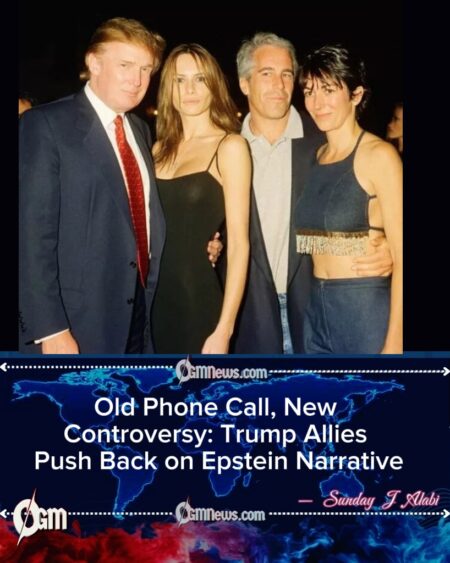
Supporters of President Donald Trump, who is currently serving a second term as U.S. president, have sought to reinterpret newly resurfaced evidence indicating that he may have been aware of Jeffrey Epstein’s criminal conduct prior to publicly acknowledging it. The controversy follows reporting that a former Palm Beach police chief told the FBI in 2019 that Trump telephoned him in 2006 to commend law enforcement efforts against Epstein, whose arrest for sex crimes had just become public.
The account appears to contrast with Trump’s 2019 assertion that he had “no idea” about Epstein’s crimes. As details from the FBI interview have circulated, Trump allies have offered alternative interpretations, arguing that the president’s remarks at the time reflected support for police action rather than prior knowledge of wrongdoing.
Former Police Chief’s Account Resurfaces
The issue gained renewed attention after journalist Julie Brown of the Miami Herald reported that Michael Reiter, the retired Palm Beach police chief, confirmed the authenticity of a partially redacted FBI document posted online by the U.S. Department of Justice. The document summarized a 2019 FBI interview in which Reiter described a phone call he said he received from Trump in July 2006.
According to Reiter’s account, Trump called shortly after Epstein’s arrest had been reported in local newspapers. Reiter told investigators that Trump said: “Thank goodness you’re stopping him, everyone has known he’s been doing this.” The statement has drawn scrutiny because of its suggestion that knowledge of Epstein’s behavior may have been widespread in certain social circles.
Reiter’s confirmation has added weight to the document’s contents, prompting fresh debate over what Trump knew and when.
Apparent Contradictions With Public Statements
In 2019, when Epstein was again arrested on federal sex trafficking charges, Trump publicly stated that he “had no idea” about Epstein’s criminal conduct. That claim is now being compared to the 2006 phone call described by Reiter.
Critics argue that the remark attributed to Trump implies awareness of allegations surrounding Epstein as early as 2006. Supporters, however, contend that the president’s words were spoken after Epstein’s arrest became public knowledge and therefore do not necessarily indicate prior or private awareness.
The differing interpretations underscore the broader political divide that has long characterized public discussion of Trump’s past associations.
Trump’s Supporters Offer Alternative Framing
In response to the renewed attention, several Trump supporters and conservative media figures have suggested that the 2006 phone call demonstrates that Trump supported law enforcement action against Epstein. Some commentators have described the call as evidence that he welcomed the investigation.
On a podcast hosted by associates of conservative activist Charlie Kirk, hosts argued that the president’s remarks could be viewed as akin to whistleblowing or, at minimum, as approval of accountability measures.
These arguments have circulated widely on social media, reflecting efforts among some supporters to reframe the narrative in a more favorable light.
Journalist Pushes Back on Interpretation
Julie Brown, whose investigative reporting in 2017 and 2018 was instrumental in bringing renewed federal scrutiny to Epstein and his associate Ghislaine Maxwell, responded to the reinterpretations online. She emphasized that the call described by Reiter occurred after Epstein’s arrest had already been reported publicly.
Brown noted that Palm Beach police had been investigating Epstein since 2005 and that the arrest in 2006 was already in the public domain at the time of Trump’s alleged phone call. Her clarification sought to distinguish between private knowledge of criminal activity and reactions to publicly available information.
The exchange highlights the complexities involved in assessing statements made two decades ago amid evolving legal proceedings.
The Maxwell Comments Add to Scrutiny
The controversy has also revived attention to Trump’s past remarks about Ghislaine Maxwell. According to the FBI interview summary, Reiter recalled Trump referring to Maxwell as “evil” during the 2006 phone call.
However, in 2020, after Maxwell was arrested on federal charges related to Epstein’s trafficking activities, Trump stated during a White House press conference: “I just wish her well.” The comment drew criticism at the time and has resurfaced in the current debate.
Observers note that the contrast between the two statements — one reportedly condemning Maxwell and another publicly expressing well wishes — has further fueled questions about consistency.
Broader Political and Legal Context
The renewed focus on Donald’s past association with Epstein comes amid ongoing public interest in transparency surrounding Epstein-related investigations. Although Epstein died in federal custody in 2019, legal proceedings against Maxwell resulted in her conviction in 2021 on federal sex trafficking charges.
The political ramifications of renewed scrutiny remain uncertain. While critics argue that the revelations merit closer examination, supporters maintain that no evidence has emerged showing that Trump engaged in criminal conduct connected to Epstein.
As documents continue to be reviewed and interpreted, the episode underscores how past relationships and statements can resurface to shape present-day political discourse.
[…] […]