



























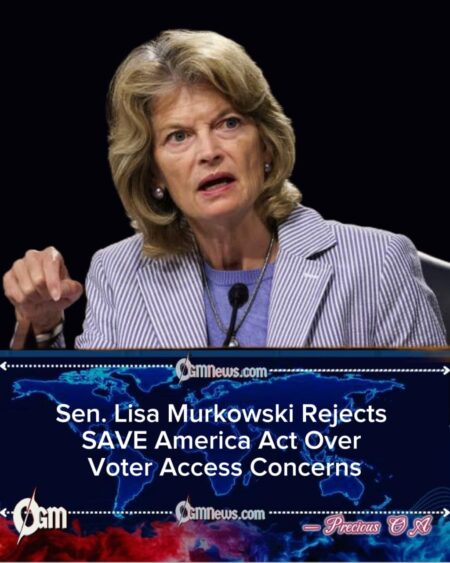
Sen. Lisa Murkowski publicly rejected advancing the SAVE America Act, a Republican-backed proposal that would require nationwide voter identification and proof of U.S. citizenship to participate in federal elections. Her stance immediately set her apart from much of her party, which has framed the legislation as a cornerstone of election integrity reform.
Sen. Lisa Murkowski emphasized that while election security remains important, she believes the bill goes too far and risks disenfranchising eligible voters, particularly in rural and Indigenous communities across Alaska. She argued that logistical barriers, not fraud, pose the greatest threat to voter participation.
Sen. Lisa Murkowski also cautioned against federal overreach, stressing that states have long held primary responsibility for administering elections. In her view, a one-size-fits-all mandate could undermine local election systems that already function effectively.
Republican Divide Over Election Reform
The SAVE America Act has exposed growing fractures within the Republican Party, especially between lawmakers pushing aggressive election reforms and those urging caution. Supporters argue that uniform voter ID laws are necessary to restore public trust after years of contested elections.
Sen. Lisa Murkowski has repeatedly found herself on the moderate edge of these debates, often prioritizing state-specific realities over national party messaging. Her opposition underscores how regional differences complicate efforts to pass sweeping federal legislation.
Party leaders have attempted to rally support by portraying the bill as a common-sense safeguard, but dissent from figures like Murkowski has slowed momentum and introduced uncertainty about its prospects in the Senate.
Concerns About Voter Access and Equity
Critics of the SAVE America Act argue that requiring proof of citizenship and standardized voter ID could disproportionately affect marginalized groups. Rural voters, seniors, Native Americans, and low-income citizens may face challenges obtaining required documentation.
Sen. Lisa Murkowski echoed these concerns, pointing to Alaska’s unique geography and limited access to government offices. She warned that policies designed without these realities in mind could unintentionally suppress lawful votes.
Voting rights organizations have seized on her comments as evidence that opposition to the bill is not purely partisan, but rooted in practical considerations about access, fairness, and administrative burden.
Federal Authority Versus State Control
At the heart of the debate lies a broader constitutional question: how much authority should the federal government exert over elections? States have traditionally maintained autonomy over voter registration and identification requirements.
Sen. Lisa Murkowski argued that federal mandates risk eroding that balance, especially when states already meet baseline security standards. She suggested that targeted improvements, rather than sweeping legislation, would be more effective.
Legal experts note that imposing nationwide standards could invite court challenges, particularly from states that view the act as an infringement on their constitutional powers.
Political Fallout Within the GOP
Murkowski’s opposition has drawn criticism from conservative activists and party hardliners who see the SAVE America Act as essential to future electoral success. Some have accused her of undermining party unity at a critical moment.
Sen. Lisa Murkowski, however, has long maintained that her responsibility is to her constituents rather than party leadership. She has weathered similar backlash in the past, including primary challenges and public criticism from prominent conservatives.
Her stance highlights a recurring tension within the GOP between ideological purity and pragmatic governance, a divide that continues to shape legislative outcomes.
What Comes Next for the SAVE America Act
With Senate support uncertain, the future of the SAVE America Act remains unclear. Lawmakers may attempt to revise the bill to address concerns raised by moderates, or attach portions of it to must-pass legislation.
Sen. Lisa Murkowski signaled openness to continued discussion but made clear that significant changes would be necessary for her to reconsider. She called for bipartisan dialogue focused on strengthening elections without limiting participation.
As debate continues, the bill stands as a test of whether Congress can balance election security with access — and whether internal party divisions will ultimately determine its fate.



[…] […]