


























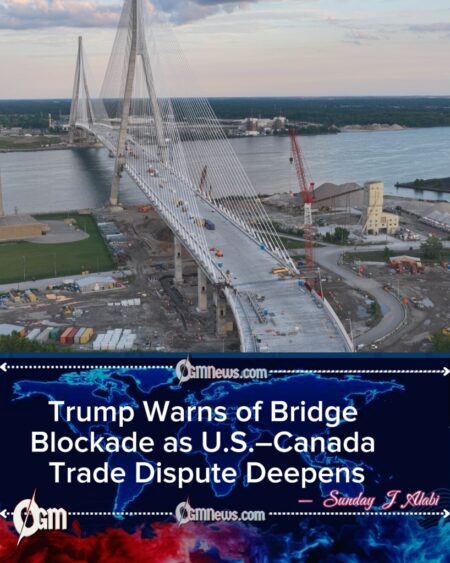
President Donald Trump, serving a second term as U.S. president, has intensified tensions with Canada by threatening to block the opening of the Gordie Howe International Bridge, a major cross-border infrastructure project linking Detroit, Michigan, and Windsor, Ontario. The warning, delivered through a lengthy social media post, comes as Democrats in the U.S. House prepare to force a vote on tariffs imposed by the Trump administration on Canadian imports. The president’s comments blend economic grievances, political recriminations, and unsubstantiated claims, drawing swift concern from lawmakers and business leaders on both sides of the border.
Trump Administration Rising Trade Frictions With a Key Partner
Canada is the United States’ second-largest trading partner, and the two economies are deeply integrated through manufacturing supply chains, agriculture, and energy. President Trump has repeatedly argued that Canada has benefited unfairly from this relationship, asserting that past trade arrangements favored Ottawa at Washington’s expense. In his latest remarks, he revived those claims, describing decades of economic interaction as unbalanced.
The timing of the statements is notable. Congressional Democrats are moving to challenge tariffs imposed by the administration, a step that underscores growing domestic debate over the economic costs of the trade strategy. Businesses dependent on cross-border trade have warned that escalating disputes risk higher prices, disrupted supply chains, and job losses in regions closely tied to Canadian commerce.
The Gordie Howe International Bridge at the Center
At the heart of the controversy is the $4.6 billion Gordie Howe International Bridge, a binational project designed to ease congestion at one of North America’s busiest commercial crossings. Approved during the Obama administration, the bridge received bipartisan backing and was publicly endorsed by President Trump himself in 2017 in a joint statement with then Canadian prime minister Justin Trudeau.
Construction began in 2018 and is nearing completion. In January, the U.S. Department of Homeland Security formally designated the bridge an official port of entry, a procedural step typically signaling readiness for operation. The president Trump threat to block its opening until the United States is “fully compensated” introduces uncertainty around a project long viewed as essential to regional economic growth.
Political Disputes and Conflicting Records
In his remarks, President Trump criticized former president Barack Obama for approving the bridge, characterizing the decision as ill-considered. He did not reference his own prior endorsement of the project or the practical considerations that led Michigan officials to support it. In 2012, then governor Rick Snyder accepted a Canadian offer to fund most of the bridge’s costs, using executive authority to bypass a reluctant state legislature.
That decision reflected the strategic importance of the crossing to Michigan’s economy, particularly the automotive sector. Industry leaders have consistently argued that modernizing border infrastructure is critical to maintaining competitiveness. The renewed political dispute now places those economic arguments in tension with broader trade negotiations.
Tariffs, China, and Diplomatic Fallout
The president’s comments also targeted Canada’s recent outreach to China following U.S. tariff increases. President Trump warned that closer trade ties between Ottawa and Beijing would harm Canadian interests, suggesting that China would dominate any such relationship. Analysts note that Canada’s diversification efforts are partly a response to uncertainty created by U.S. trade policy.
In an unusual aside, the president claimed—without evidence—that increased trade with China could lead to restrictions on ice hockey in Canada, including the elimination of the Stanley Cup. The statement drew widespread disbelief and underscored the rhetorical intensity of the administration’s messaging. Canadian officials and diplomats have largely declined to respond publicly, opting instead to emphasize the stability of existing agreements.
Reactions From Lawmakers and Stakeholders
U.S. lawmakers, particularly those representing border states, expressed alarm at the potential consequences of blocking the bridge. Senator Elissa Slotkin of Michigan warned that canceling or delaying the project would raise costs for businesses, weaken supply chain security, and threaten jobs. She argued that the dispute risks penalizing local economies for a trade conflict initiated at the federal level.
Business groups echoed those concerns, emphasizing that infrastructure uncertainty can deter investment. While the Canadian embassy in Washington and the bridge authority did not immediately comment, past statements from both have highlighted the project’s economic rationale and the shared benefits for the two countries.
Implications for North American Trade
President Trump has signaled that further measures could follow if Canada proceeds with ai trade agreement with China, including the possibility of imposing tariffs as high as 100 percent. Such steps would mark a significant escalation and could test the resilience of North American trade frameworks.
As negotiations and political maneuvering continue, the fate of the Gordie Howe International Bridge has become symbolic of broader tensions. The coming weeks may determine whether pragmatic economic considerations prevail or whether trade disputes further complicate one of the world’s most extensive bilateral economic relationships.
[…] […]