




























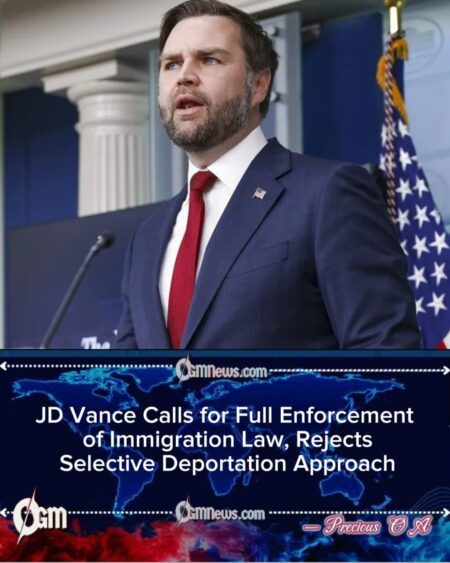
JD Vance outlined an uncompromising stance on immigration during recent public remarks, saying his goal is the removal of every individual residing in the United States without legal authorization, not only those who commit additional crimes. He framed the position as a matter of enforcing existing law rather than selectively applying it.
The comments immediately drew national attention because they go beyond the more common political emphasis on deporting individuals with violent or serious criminal records. Supporters argue the clarity removes ambiguity from enforcement priorities, while critics say the language risks oversimplifying a complex policy area.
The statement reflects a broader debate within American politics over whether immigration enforcement should be discretionary or absolute. That tension has intensified as border security, asylum backlogs, and labor concerns continue to dominate congressional discussions.
Legal Foundations and Enforcement Debate
JD Vance argued that immigration law loses credibility when it is enforced unevenly, asserting that selective removal policies undermine public trust. He emphasized that Congress, not executive discretion, defines who may legally remain in the country.
From a legal perspective, immigration statutes already provide mechanisms for removal, though limited resources have historically forced prioritization. Administrations of both parties have used prosecutorial discretion to focus on certain categories of migrants.
Policy analysts note that an all-encompassing enforcement approach would require significant expansions in funding, personnel, detention capacity, and immigration court resources. Without those investments, broad mandates risk clashing with practical constraints.
Political Strategy and Messaging
JD Vance framed his remarks as a response to what he described as inconsistent messaging from political leaders on immigration. By drawing a clear line, he sought to distinguish his position from proposals centered solely on criminal activity.
JD Vance also linked immigration enforcement to fairness for legal immigrants, arguing that those who follow established pathways are disadvantaged when unlawful presence is tolerated. This framing has become increasingly common among lawmakers advocating stricter controls.
Political strategists observe that such messaging resonates with voters who view immigration primarily through a rule-of-law lens, though it may alienate moderates concerned about humanitarian implications.
Economic and Labor Considerations
JD Vance acknowledged that large-scale removals would have economic consequences, particularly in industries that rely heavily on immigrant labor. He suggested that long-term stability requires legal workforce solutions rather than dependence on unauthorized employment.
Business groups have warned that abrupt enforcement shifts could disrupt agriculture, construction, and service sectors. Some economists argue that transitional programs or expanded legal work visas would be necessary to offset labor shortages.
JD Vance maintained that economic concerns should not override statutory enforcement, emphasizing that market adjustments must align with lawful immigration systems rather than perpetuating irregular ones.
Public Reaction and Institutional Response
Public reaction to the remarks has been sharply divided, with advocacy organizations expressing concern about potential family separations and community impacts. Civil liberties groups argue that broad removal rhetoric can heighten fear among mixed-status households.
JD Vance responded to criticism by reiterating that compassion and enforcement are not mutually exclusive, pointing to the role of Congress in reforming immigration pathways if changes are needed.
State and local officials have also weighed in, noting that federal enforcement priorities directly affect local resources. Coordination between agencies remains a key issue in any expanded removal strategy.
JD Vance Within the Broader GOP Landscape
Within Republican circles, JD Vance’s position places him among lawmakers advocating maximal enforcement rather than incremental tightening. The approach contrasts with factions focused on border security technology or asylum reform as primary tools.
Some party leaders see the clarity as politically advantageous, offering a straightforward contrast with Democratic proposals. Others caution that absolutist language may complicate future legislative negotiations.
JD Vance has signaled that he views firm positioning as a starting point for debate, not necessarily the final shape of policy, emphasizing that legislative processes will ultimately determine outcomes.
Implications for Future Policy
Looking ahead, immigration experts say the feasibility of such an approach depends on congressional action. Without statutory changes or substantial appropriations, enforcement agencies may struggle to meet expansive expectations.
JD Vance reiterated that his comments were intended to reset the conversation around accountability and legality, urging lawmakers to confront the scale of unauthorized immigration directly.
The debate underscores a central challenge in U.S. immigration policy: balancing enforcement, economic needs, humanitarian concerns, and political realities. How those elements are reconciled will shape the next phase of national immigration reform.


Ae888covenuscasino, okay, I'm curious. Gonna check out this site and try to find some amazing...