




























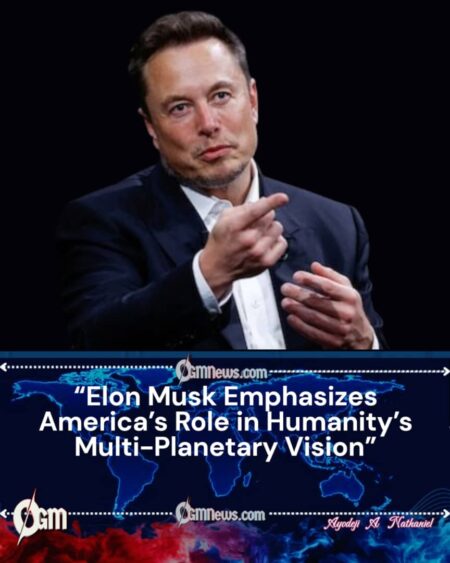
Washington / Austin — Technology entrepreneur and SpaceX founder Elon Musk has warned that a dramatic ideological shift in the United States could threaten long-term scientific progress, including humanity’s ambition to become a multi-planetary species. Speaking in broad terms, Musk argued that national stability and institutional strength are prerequisites for sustaining the technological momentum required for space exploration.
Musk’s remarks, shared publicly and widely circulated online, frame America’s political and economic direction as inseparable from its capacity to lead in advanced innovation. His comments have reignited debate over the relationship between governance, ideology, and long-term scientific investment.
Musk’s Core Argument on Progress and Survival
According to Musk, large-scale projects such as space colonization require decades of continuity, capital investment, and political stability. He suggested that systems he characterizes as “leftist communism” risk weakening incentives for innovation and long-term planning.
In his view, America’s role as a technological anchor is not merely national but civilizational. Without sustained leadership, Musk argues, efforts to extend human life beyond Earth could stall or collapse entirely.
America’s Role in Space Leadership
The United States has historically played a dominant role in space exploration, from the Apollo missions to modern commercial partnerships with private firms such as SpaceX. Musk emphasized that this leadership depends on a robust economy, predictable institutions, and consistent policy support.
Industry analysts note that major space initiatives require cooperation between government agencies, private companies, and global partners. Any disruption to that ecosystem, whether political or economic, could have long-term consequences for exploration timelines.
Political Ideology and Innovation Debate
Musk’s comments have drawn mixed reactions. Supporters argue that his warning reflects historical lessons, pointing to innovation slowdowns in heavily centralized systems. They contend that free-market incentives and competition have been central to technological breakthroughs.
Critics counter that innovation can occur under a variety of political systems and caution against framing complex policy debates in ideological absolutes. They argue that public investment and regulation have also played critical roles in scientific advancement.
Reaction from the Tech and Policy Communities
Within the technology sector, Musk’s remarks were seen as consistent with his long-standing emphasis on long-term thinking and existential risk. Some executives echoed concerns about policy instability affecting research, infrastructure, and capital formation.
Policy analysts, however, urged nuance, noting that space exploration has historically combined private enterprise with strong public funding. They suggest the real challenge lies in balancing innovation incentives with social and economic cohesion.
The Multi-Planetary Vision
Musk has repeatedly stated that making humanity multi-planetary—particularly through settlement on Mars—is essential to long-term survival. He argues that Earth-bound civilization remains vulnerable to extinction-level events without an off-world backup.
Whether one agrees with his political framing or not, experts acknowledge that achieving such a vision would require sustained global cooperation, technological breakthroughs, and decades of uninterrupted progress.
Broader Implications
The comments add to a growing trend of business leaders weighing in on political and ideological issues with global implications. As technology increasingly shapes humanity’s future, debates over governance and innovation are likely to intensify.
For now, Musk’s warning serves as another reminder that discussions about space exploration are no longer confined to science fiction or engineering labs, but are deeply entangled with questions of politics, economics, and national direction.



[…] […]