




















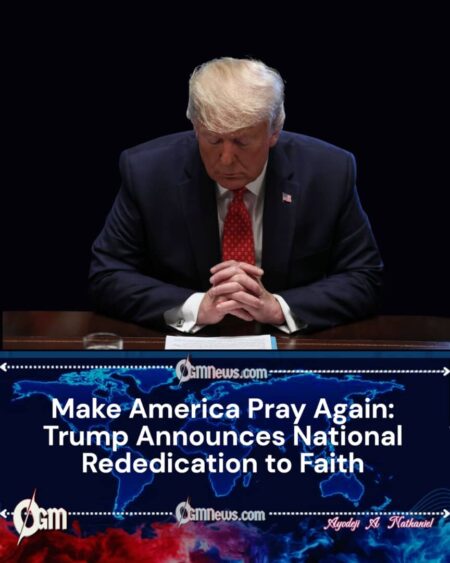
In a declaration that has quickly become one of the most discussed political and cultural moments of the year, President Donald Trump announced that the United States will formally “rededicate itself to God” on May 17, 2026. The announcement, framed around the phrase “one nation under God,” was presented as a symbolic reaffirmation of national values rather than a shift in law or governance.
The statement has reverberated across political, religious, and civic spaces, prompting renewed examination of the role faith plays in American public life. Supporters see the move as a return to moral foundations, while critics warn it risks blurring long-established constitutional boundaries.
The Announcement and the White House’s Framing
According to the White House, the rededication will be ceremonial in nature, involving voluntary prayer, reflection, and civic observances nationwide. President Donald Trump emphasized that the initiative is not tied to legislation and does not mandate religious participation.
Senior administration officials described the plan as a moment of national reflection intended to promote unity, moral responsibility, and shared heritage. They underscored that the language used mirrors expressions already embedded in American civic traditions, including the Pledge of Allegiance.
Religion and the American Political Tradition
Religion has consistently occupied a visible, if carefully balanced, place in U.S. public life. From presidential inauguration that features clergy to national days of prayer proclaimed by past leaders, faith has long intersected with civic ritual.
Historians note that American presidents have often invoked God during times of uncertainty while stopping short of establishing religious doctrine as state policy. The current announcement follows this historical pattern, though its explicit framing has intensified scrutiny.
Constitutional Boundaries and Legal Analysis
The First Amendment’s dual guarantees protecting free exercise of religion while prohibiting the government establishment of religion stand at the center of legal debate surrounding the rededication. Constitutional scholars largely agree that symbolic acknowledgments of faith can be lawful if inclusive and voluntary.
However, legal experts caution that messaging and implementation will be critical. Should the initiative be perceived as endorsing a specific faith tradition, challenges could arise. President Donald Trump has insisted that the observance will respect religious freedom in all its forms.
Political Responses and Partisan Perspectives
Reactions from lawmakers and political groups have been sharply divided. Conservative leaders applauded the announcement as a long-overdue recognition of the spiritual values they believe underpin American society, praising President Donald Trump for addressing a core concern of his political base.
Opposition figures urged restraint, arguing that government leaders must be careful not to conflate national identity with religious belief. Several civil liberties organizations called for transparency and inclusivity as planning moves forward.
Faith Leaders, Civic Groups, and Public Opinion
Religious responses have been diverse. Evangelical Christian organizations broadly welcomed the announcement, viewing it as an affirmation of faith’s role in shaping ethical leadership. Interfaith groups, while supportive of spiritual reflection, emphasized the need to ensure that Americans of all beliefs feel included.
Secular advocacy groups expressed concern that the language used could marginalize non-religious citizens. Meanwhile, early public opinion surveys suggest a nation divided, with strong support and strong opposition reflecting broader cultural fault lines. President Donald Trump has acknowledged these divisions while urging Americans to view the event as unifying rather than exclusionary.
Implications for Governance and National Identity
Beyond the immediate reactions, analysts say the rededication may have lasting implications for political discourse. Symbolic acts by a sitting president often shape national narratives, influencing how citizens perceive the relationship between government, values, and identity.
As preparations continue, observers note that the tone adopted by the administration could determine whether the rededication becomes a moment of collective reflection or sustained controversy. President Donald Trump has indicated that the event will be a defining symbolic moment of his second term.


[…] […]