
























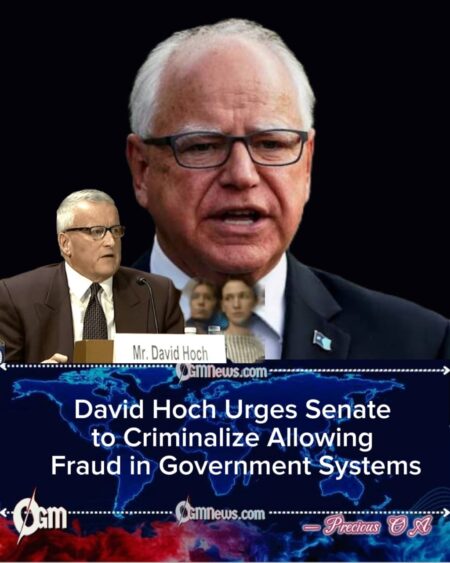
David Hoch told members of the U.S. Senate that existing laws fail to adequately address systemic fraud, arguing that institutions and individuals who knowingly allow fraudulent activity should face criminal consequences. His testimony framed the issue as a structural weakness rather than a series of isolated offenses.
Hoch’s remarks came during a hearing focused on financial integrity, regulatory enforcement, and public trust in government systems. Lawmakers from both parties questioned whether current civil penalties are sufficient to deter large-scale abuse.
The testimony emphasized that fraud often persists not because of a lack of detection, but because of gaps in accountability when warning signs are ignored or deliberately overlooked.
The Case for Criminal Liability
David Hoch argued that civil fines and administrative penalties are frequently absorbed as operating costs, particularly by large institutions. He said this dynamic undermines deterrence and incentivizes risk-taking at the expense of taxpayers and consumers.
David Hoch told senators that criminal liability would fundamentally alter internal decision-making, forcing executives and supervisors to prioritize compliance rather than tolerate questionable practices.
Legal analysts note that expanding criminal standards would mark a significant shift in enforcement philosophy, moving from corrective regulation toward personal accountability.
David Hoch and Institutional Responsibility
David Hoch emphasized that fraud rarely occurs without multiple points of failure, including supervisors, compliance officers, and governing boards. He said accountability should extend beyond the individual who directly commits the act.
The testimony highlighted cases in which internal reports or audits identified irregularities that were later ignored, delayed, or suppressed. Hoch argued that such inaction enables harm on a far larger scale.
Policy experts observing the hearing said Hoch’s argument aligns with broader calls for governance reform, particularly in sectors where oversight relies heavily on self-reporting.
Senate Response and Legislative Interest
Several senators expressed interest in examining whether existing statutes sufficiently address willful blindness or negligent oversight. Questions focused on how lawmakers might distinguish between reasonable error and deliberate allowance of fraud.
David Hoch responded that intent can often be established through documentation, internal communications, and repeated failure to act after warnings. He stressed that the standard should focus on patterns rather than isolated mistakes.
Committee members indicated that further hearings may be scheduled to explore potential legislative language and constitutional considerations.
Implications for Regulatory Enforcement
David Hoch said criminalizing the allowance of fraud would strengthen regulatory agencies by giving them clearer enforcement pathways. He argued that regulators often lack leverage when violations stop short of direct criminal conduct.
Enforcement officials have long noted the difficulty of pursuing cases where responsibility is diffused across complex organizational structures. Hoch suggested that clearer standards could reduce ambiguity.
Critics caution that overly broad statutes could discourage legitimate risk-taking or overwhelm the courts, underscoring the need for precise legal definitions.
Broader Impact on Public Trust
David Hoch concluded that accountability is essential to restoring confidence in both government and private institutions. He said public faith erodes when wrongdoing appears to be tolerated at higher levels.
Public-interest advocates echoed this view, arguing that visible enforcement reinforces fairness and deters future misconduct. They note that trust is particularly fragile during periods of economic uncertainty.
As lawmakers consider next steps, the testimony has added momentum to ongoing debates about the balance between regulation, enforcement, and responsibility in preventing systemic fraud.

[…] […]