
























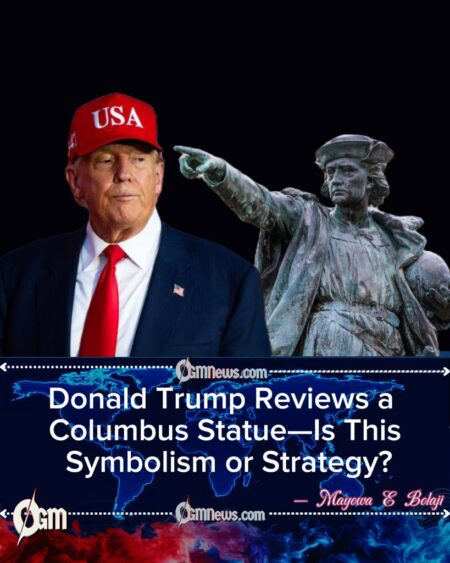
President Donald Trump, the current U.S. president serving a second term, is considering the installation of a Christopher Columbus statue near the White House—one modeled on a monument that was torn down and dumped into the water of a major Democratic-led city during the unrest of the summer of 2020. The proposal has reopened long-running national debates over history, public memory, and the role of monuments in a deeply polarized America.
A Proposal Rooted in a Turbulent Past
The statue under consideration is linked to a Columbus monument that was removed during the wave of protests and civil disorder that swept several U.S. cities in 2020. At the time, statues associated with colonialism and slavery became targets of demonstrators who argued such symbols no longer reflected modern American values.
Supporters of the former monument said its destruction represented lawlessness and historical erasure, while critics viewed it as a long-overdue reckoning with the darker chapters of Western expansion. By revisiting this particular statue, the White House is touching a nerve that remains sensitive five years later.
Symbolism and the White House Setting
Placing a Columbus statue near the White House would give the monument heightened national visibility and symbolic weight. The area surrounding the executive mansion is carefully curated, with monuments typically reflecting foundational ideals or widely shared historical narratives.
Administration officials familiar with the discussions say the proposal is being framed as a statement about preserving history rather than endorsing any single interpretation of it. Nevertheless, the proximity to the White House ensures the statue would be read not just as art, but as a political message.
Supporters See History and Order
Supporters of the idea argue that Columbus statues honor exploration, migration, and the historical roots of the Americas. They contend that removing monuments under pressure from protests sets a dangerous precedent and undermines respect for law and order.
Some conservative groups also view the plan as a corrective to what they describe as selective historical judgment. For them, restoring a statue once destroyed during unrest carries symbolic value beyond the figure of Columbus himself.
Critics Warn of Division and Exclusion
Opponents say the proposal risks reopening wounds at a time when national unity remains fragile. Indigenous groups and civil rights advocates have long criticized Columbus monuments, arguing they celebrate conquest and ignore the suffering of native populations.
Critics also question whether installing such a statue near the White House aligns with efforts to build a more inclusive public narrative. They warn that the move could be perceived as dismissive of communities whose objections to Columbus symbolism are rooted in historical experience.
Political Context in a Second Trump Term
The discussion comes as President Trump continues to shape his second term around themes of national identity, cultural pushback, and resistance to what he calls revisionist history. Symbolic actions, including monument policy, have become a recurring feature of this approach.
While no final decision has been announced, the deliberations reflect broader tensions between preservation and reinterpretation of history—tensions that have defined American political discourse since 2020.
What Comes Next
Any plan to install a new monument near the White House would require coordination with federal agencies, historical commissions, and local authorities. Public consultations and legal reviews are also likely if the proposal advances.
For now, the Columbus statue remains an idea under consideration. Whether it becomes a permanent fixture near the nation’s most powerful address or remains a political signal, the debate it has sparked underscores how deeply the past continues to shape America’s present.
[…] […]