






















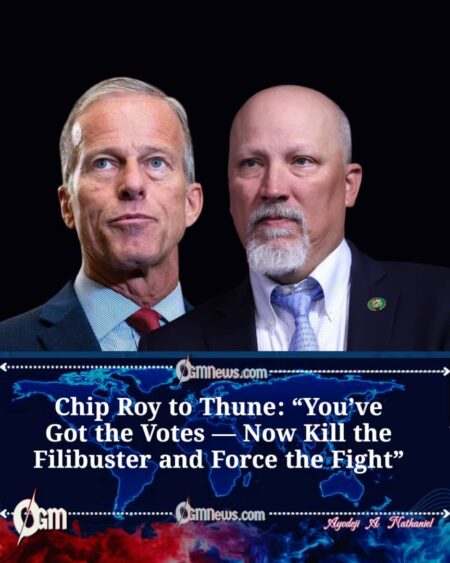
Rep. Chip Roy has intensified pressure on Senate Republicans, claiming the chamber already has 50 Republican votes ready to pass the SAVE America voter ID and citizenship Act—if Senate leadership is willing to change the rules to make it possible.
Roy’s message is aimed squarely at Senate Republican Leader John Thune, urging him to “nuke” the Senate’s 60-vote filibuster threshold, which effectively requires bipartisan support to advance most major legislation. Roy argued that once Democrats stop speaking, Republicans could force the vote and deliver what he described as a long-overdue election security win.
Roy’s Claim: The SAVE Act Has the Votes—If the Rules Change
Roy’s central assertion is that Republicans have the numbers needed to pass the SAVE Act under a simple majority standard. In a 50–50 environment, the tie-breaking vote could come from the vice president, meaning the bill could potentially pass without Democratic support—but only if it reaches the floor under rules that allow it.
His argument highlights a strategic reality: in today’s Senate, major bills can be blocked not because they lack support, but because they cannot overcome the procedural hurdle of cloture, the vote required to end debate.
By saying the Senate “has 50 votes,” Roy is signaling that the obstacle is no longer internal Republican unity—it is leadership willingness to confront Senate procedure.
Why Roy Wants Thune to “Nuke” the Filibuster
Roy’s demand centers on ending what he calls the “60-vote Zombie Filibuster,” which requires 60 votes to close debate on most legislation. Without 60 votes, bills often stall indefinitely, regardless of majority support.
Roy argues that Republicans should not continue operating under a system that empowers Democrats to block election-related bills. In his view, the filibuster has become less of a tool for compromise and more of a weapon for permanent obstruction.
However, eliminating the filibuster remains one of the most controversial moves in U.S. governance. While it could unlock rapid passage of Republican priorities now, it would also allow Democrats to pass sweeping legislation later when they regain Senate control—raising fears of political whiplash and unstable lawmaking.
The SAVE Act Debate: Voter ID and Citizenship Requirements
The SAVE Act is framed by supporters as an election integrity measure designed to ensure that only eligible citizens vote in U.S. elections. Backers argue voter ID and citizenship verification are basic safeguards that improve confidence in the electoral system.
Roy and other Republicans view the bill as a necessary response to public concerns about fraud, weak enforcement, and administrative loopholes. The rhetoric around the bill often emphasizes national sovereignty, lawful voting, and prevention of non-citizen participation.
Democrats, however, generally argue that such requirements risk restricting lawful voters—particularly those without easy access to government-issued identification or citizenship documents. Civil rights groups have also warned that strict rules can lead to eligible voters being turned away due to paperwork errors, mismatched records, or administrative confusion.
How a Vote Could Be Forced: The Floor Strategy Roy Outlined
Roy suggested a tactical route: if all 50 Republican senators stand united on the Senate floor demanding a vote, Republicans could eventually force action once Democrats stop speaking.
This reflects the procedural reality of the Senate: prolonged debate, delay tactics, and filibuster-like resistance can stall a bill, but sustained floor pressure can also shift the political cost onto the blocking party—especially if media coverage frames Democrats as preventing a vote on “election security.”
Still, without a rule change or a successful cloture vote, the SAVE Act could remain trapped in Senate gridlock. Roy’s strategy is as much political theater as it is legislative planning—designed to rally public pressure and force Senate leadership to act.
Bigger Picture: Republicans Testing a New Senate Era
Roy’s comments show a broader Republican trend: increasing willingness to challenge institutional norms in order to deliver tangible policy victories. In this environment, the filibuster is no longer treated as a sacred tradition but as a barrier to governing.
If Republicans eliminate or weaken the filibuster to pass election legislation, it would represent a historic shift in Senate power dynamics. It would also likely trigger retaliation or reversal later—meaning election laws could change repeatedly depending on who holds power.
For now, Roy’s message is clear: Republicans should stop negotiating with Senate procedure and start using their majority power to deliver results.
What Happens Next
The immediate question is whether Leader John Thune will entertain rule changes or continue defending the filibuster as a Senate tradition. If Thune resists, Roy and House conservatives may intensify their pressure campaign through media, grassroots organizing, and public demands for floor action.
The SAVE Act could become a defining test of Republican unity—not on the bill itself, but on whether the party is willing to rewrite Senate rules to achieve its goals.


My interest in numismatics has grown recently. I was looking for numismatic articles, but many...