















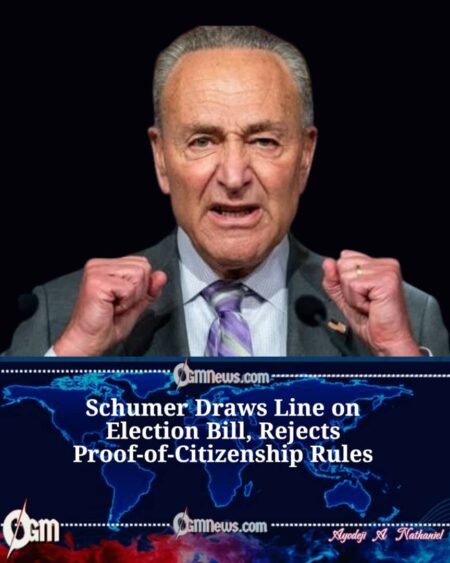
Senate Majority Leader Chuck Schumer has announced that Democrats intend to block provisions requiring voter identification and proof of citizenship in the proposed SAVE Act, escalating a long-running political fight over election security and voting rights in the United States.
Schumer’s statement signals that the bill—framed by supporters as a safeguard against illegal voting—will face unified resistance from Democrats who argue that such measures risk restricting lawful participation and disproportionately affecting certain groups of voters. The dispute is expected to intensify in Congress as both parties position themselves ahead of upcoming national elections.
Schumer’s Warning: Democrats Will Stop the SAVE Act Requirements
Schumer’s remarks indicate Democrats are prepared to use Senate procedural tools and caucus discipline to prevent the voter ID and citizenship requirements from advancing. The move reflects the party’s broader view that election reforms should prioritize access, convenience, and protection against voter suppression.
Democrats have repeatedly argued that strict voter ID rules and proof-of-citizenship demands can create barriers for eligible voters—particularly low-income Americans, elderly citizens, students, and people without updated documentation.
Schumer’s stance is also a political message: Democrats are signaling they will not allow Republicans to redefine election policy through federal mandates that could reshape how states administer voter eligibility.
Republican Argument: Election Security and Citizenship Verification
Supporters of the SAVE Act argue that the legislation is a necessary response to public concerns about election integrity. They contend that requiring proof of citizenship and valid identification is a basic standard that strengthens trust in the democratic process.
Republicans frequently emphasize that only U.S. citizens should vote in federal elections, and they argue that stronger verification reduces the possibility of loopholes, administrative error, or abuse.
Even where evidence of widespread illegal voting is disputed, the political potency of “election security” remains strong—making the SAVE Act a key messaging tool as Republicans attempt to portray Democrats as weak on enforcement.
Democratic Counterargument: Voting Rights and Practical Barriers
Democrats, led by Schumer in this case, argue that election security can be improved without measures they see as restrictive. They warn that voter ID and proof-of-citizenship requirements can cause legitimate voters to be turned away due to documentation issues, name mismatches, lost records, or difficulties obtaining IDs.
Civil rights organizations have also historically criticized these requirements, arguing they may disproportionately impact minority communities and could be used politically to shape turnout rather than protect elections.
For Democrats, the SAVE Act debate is not just about procedure—it is about principle: they frame it as a defense of voting rights and a rejection of what they consider politically motivated barriers.
A High-Stakes Senate Battle With National Consequences
Schumer’s declaration sets up a high-stakes confrontation that will likely involve Senate votes, media campaigns, and heavy partisan framing. Even if the SAVE Act does not pass in its current form, the debate itself could influence public perception and energize both political bases.
The issue is expected to play out not only in Washington but also in state legislatures and courts, as states continue to revise voting laws and registration systems.
Ultimately, the SAVE Act fight reflects a broader national struggle: whether U.S. election reform should prioritize tighter enforcement mechanisms or broader voter access protections—and whether those two goals can realistically coexist.
What Happens Next
The SAVE Act provisions Schumer referenced may face procedural blocks in the Senate, potential amendments, and negotiation attempts. Republicans may attempt to force votes to put Democrats on record, while Democrats may frame their resistance as protecting constitutional voting rights.
As election season approaches, both sides are likely to use the issue as a defining political contrast: security vs access, verification vs inclusion, fraud prevention vs suppression concerns.
Schumer’s comments make one point clear: Democrats are preparing for a direct showdown over the bill.
My interest in numismatics has grown recently. I was looking for numismatic articles, but many...