

















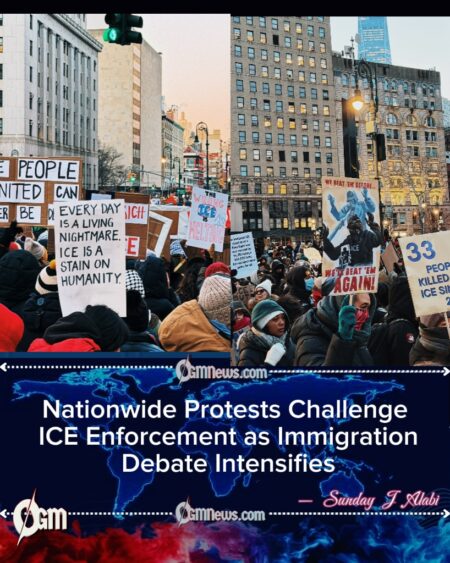
Thousands of protesters poured into streets across the United States on Friday in a coordinated national day of action against Immigration and Customs Enforcement (ICE), demanding an end to what organizers describe as the Trump administration’s violent and far-reaching immigration crackdown. The demonstrations, which unfolded in major cities and small communities alike, combined mass marches, student walkouts, and economic boycotts aimed at pressuring federal authorities to withdraw immigration agents from targeted regions, particularly Minnesota.
The protests were sparked by growing anger over recent deaths linked by activists to ICE operations, including the killings of Renee Good and Alex Pretti in Minneapolis. Organizers framed the day’s actions as both a moral stand and a strategic escalation, calling for widespread disruption under the slogan “no work, no school, no shopping,” in order to draw national attention to immigration enforcement practices under President Donald Trump, the current U.S. president serving a second term.
A Coordinated Day of Action Across the United States
Demonstrations took place in dozens of cities, with protesters gathering at city halls, courthouses, statehouses, and other government buildings. According to action trackers, rallies were reported in Philadelphia, New York, Boise, Columbus, Milwaukee, and Buffalo, Wyoming, among others. In parks and on street corners, participants carried signs calling for ICE to be defunded or removed entirely from their communities.
In New York City, thousands marched through freezing temperatures, chanting and waving placards as snow fell. Protesters ranged from students to elderly residents, many bundled in thick coats, hats, and gloves, underscoring the breadth of participation. Similar scenes were reported in California, where large crowds filled streets in San Francisco, Oakland, and Los Angeles.
Students played a visible role nationwide. High schools and colleges in states including Florida, California, Tennessee, Texas, and Utah staged walkouts, with hundreds of young people leaving classrooms to join marches. Organizers said the scale of participation reflected mounting concern among younger Americans about immigration enforcement and civil libe
Minnesota at the Center of the Anti ICE Protests
Minnesota emerged as a focal point of the national action, following weeks of heightened ICE activity in the state. Tens of thousands had already taken part in protests and economic actions there the previous week, and Friday’s demonstrations built on that momentum. In Minneapolis and surrounding communities, some businesses closed entirely, while others remained open under alternative models designed to support protesters.
Several local businesses donated a day’s revenue to mutual aid efforts or offered free food, coffee, and safe spaces for community members. Organizers described these actions as a form of economic resistance, intended to demonstrate solidarity while easing the financial strain on residents participating in the strike.
Student organizers said the protests were fueled by grief and anger over the deaths of Renee Good and Alex Pretti. Good was shot by an ICE agent while, according to activists, attempting to protect a neighbor. Pretti was killed days later while observing ICE activity in his neighborhood. These incidents, they argue, exemplify a pattern of aggressive enforcement that has left communities fearful.
Escalation and Tensions in Los Angeles
While most demonstrations remained peaceful, tensions escalated in parts of Los Angeles by Friday evening. Outside a downtown federal building, some protesters threw bottles and other debris, spray-painted anti-ICE slogans on walls, and attempted to block entrances. Authorities responded by activating a tactical alert.
Law enforcement officers deployed chemical irritants against a crowd of approximately 200 protesters outside the Metropolitan Detention Center, a Bureau of Prisons facility used by ICE to detain immigrants. The site has become a recurring flashpoint for demonstrations, reflecting broader anger over detention practices.
Videos circulating online appeared to show protesters toppling a small structure and pushing a large dumpster to obstruct access to the building. Water bottles were thrown at officers holding clear shields marked “police.” Officials said they were monitoring the situation closely, while organizers reiterated calls for nonviolent protest despite the confrontations
Student Organizers and a Growing Movement
Leaders of Friday’s actions described the protests as part of an expanding nonviolent movement against ICE’s enforcement tactics. Kidus Yeshidagna, president of the Ethiopian Students Union at the University of Minnesota and one of the strike organizers, said the goal was to take local resistance national.
“We are calling for this strike because we believe what we have been doing in Minnesota should go national,” Yeshidagna said, adding that economic pressure through work stoppages and consumer boycotts was a key strategy. He argued that broader public engagement was needed to force accountability and reform.
Yeshidagna, who grew up in St. Paul, drew parallels between the current moment and earlier episodes of unrest following the killing of George Floyd in 2020. He said students have watched friends and family members become targets since ICE intensified operations in Minnesota, reinforcing their determination to act.
Community Support and Business Participation
Beyond marches and walkouts, the protests were marked by widespread participation from local businesses and community groups. Restaurants, clothing retailers, bookstores, and cafés across dozens of cities either closed their doors or altered operations in solidarity with the strike.
In Minneapolis, some establishments donated profits to help residents cover essential expenses such as rent. Others adopted donation-based models or suspended taxable income as a symbolic rejection of federal policies they oppose. Organizers said these gestures demonstrated how economic leverage could be used to challenge government actions.
Elected officials also voiced support. Minneapolis City Council President Elliott Payne posted footage from a high school walkout, praising students for leading the movement and urging adults to stand with them in pursuit of a more just future.
Political Context and Legislative Pressure
Friday’s protests unfolded against a tense political backdrop in Washington, where lawmakers were racing to avert a partial government shutdown. Senate Democrats, joined by some Republicans, were negotiating a funding package that would finance most federal agencies while placing limits on the Department of Homeland Security.
Democrats have sought to use the funding debate to push for reforms, including restrictions on agents wearing masks and requirements for ICE to obtain warrants before making arrests. The House of Representatives faces a deadline to pass a $1.2 trillion package to avoid a prolonged shutdown.
Activists said the timing underscored their message that immigration enforcement has become a central national issue. “This administration has never been about safety and security,” one organizer said, arguing that cruelty, rather than public protection, has driven policy decisions.


The vibes here are amazing and the winning streaks are real. It feels just like...