




















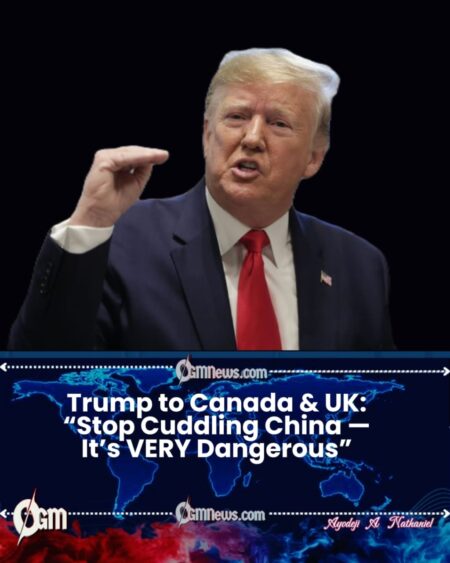
President Donald Trump, currently serving a second term as U.S. president, has sharply criticized Canada and the United Kingdom for what he described as “cozying up” to China, warning that closer economic and political engagement with Beijing could expose both countries to strategic and security risks. Speaking in blunt terms, Trump said it was “very dangerous” for allies to expand business ties with China, singling out Canada as being particularly vulnerable.
Trump’s remarks come amid renewed global debate over how Western democracies should manage relations with China—balancing trade and investment opportunities against national security concerns, supply-chain dependence, and geopolitical competition.
Trump’s Message: Allies Should ‘Back Off’ From China
In his comments, Trump framed China as a high-risk partner and argued that Western nations should be cautious about allowing Beijing to deepen its influence through business and trade. He asserted that China’s global ambitions are not merely commercial, but strategic—suggesting that economic ties could translate into political leverage.
Trump also emphasized personal familiarity with China, stating, “I know China very well,” a line consistent with his longstanding political message that Beijing uses economic partnerships to gain advantage over foreign governments and industries.
Why Canada and the UK Are Being Targeted
Canada and the United Kingdom remain among Washington’s closest allies, with deep intelligence, defense, and trade relationships with the United States. However, both countries have faced internal pressure to maintain trade links with China due to China’s massive consumer market and role in global manufacturing.
Trump’s warning reflects a broader concern within some U.S. political circles that even allied engagement with China can weaken collective Western leverage, dilute sanctions or restrictions, and increase reliance on Chinese capital, technology, and supply chains.
Economic Stakes: Trade, Investment, and Supply Chains
China remains a key global economic actor, and many Western economies continue to rely on Chinese manufacturing inputs, rare earths, and consumer goods. Any push to “back off” from China carries potential economic consequences, including higher costs, reduced access to markets, and supply-chain disruption.
At the same time, security analysts have warned that strategic industries—such as telecommunications, semiconductors, energy infrastructure, and critical minerals—may be vulnerable if Chinese firms gain access or control through investment and partnerships.
Security Concerns Driving the Debate
Trump’s remarks align with arguments that China’s international business footprint can create national security risks. Western intelligence communities have repeatedly raised concerns over cyber operations, data security, surveillance-linked technology, and potential dual-use applications of Chinese products and infrastructure.
For Canada and the UK, the debate often centers on how to remain economically competitive while limiting exposure to coercive economic tactics—such as trade restrictions, investment pressure, and diplomatic retaliation.
Diplomatic Implications for Western Unity
Trump’s public criticism could also have diplomatic consequences, particularly at a time when Western governments are attempting to coordinate on China policy through alliances and multilateral forums. While there is broad agreement among many democracies on the need for caution, approaches differ on how aggressive restrictions should be.
Some officials argue that unified policy is necessary to avoid “divide-and-conquer” tactics. Others believe engagement can still be managed through targeted safeguards rather than sweeping economic decoupling.
What Happens Next
Trump’s warning is likely to fuel continued debate about China policy across North America and Europe. It may also influence discussions on trade agreements, technology restrictions, and foreign investment screening, particularly in sectors tied to national security.
Whether Canada and the UK shift policy or maintain current engagement levels, Trump’s remarks highlight a growing reality: China is no longer treated solely as a trade partner, but increasingly as a strategic competitor shaping global alliances and economic priorities.
[…] […]