



























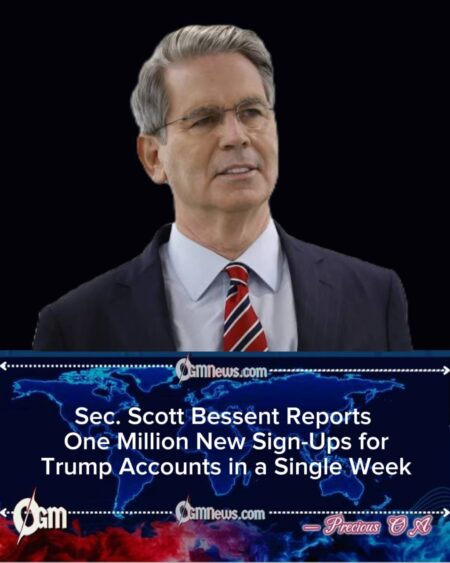
Sec. Scott Bessent disclosed this week that participation in the Trump Accounts initiative has accelerated rapidly, with roughly one million people enrolling over the past seven days alone. The announcement was made during a policy briefing, where officials outlined early indicators of public interest and engagement.
Sec. Scott Bessent described the surge as an unexpected but notable development, pointing to strong curiosity among households seeking alternative financial tools. He emphasized that the figures represent sign-ups rather than long-term participation metrics, noting that continued monitoring will be required.
The department framed the update as an initial snapshot rather than a final verdict on the program’s success. Analysts cautioned that early enrollment numbers often reflect novelty and publicity, which may stabilize as the program matures.
Sec. Scott Bessent and the Policy Rationale
Sec. Scott Bessent explained that the Trump Accounts were designed to encourage savings, financial literacy, and broader participation in the formal financial system. According to officials, the accounts aim to offer simplified access and incentives targeted at working families.
The program’s structure, as outlined by the Treasury, seeks to blend private-sector participation with federal oversight. Supporters argue that such a framework could lower barriers for individuals who have historically remained outside mainstream banking.
Sec. Scott Bessent also stressed that safeguards were built into the rollout, including compliance requirements and consumer protections. He said these measures are intended to ensure stability and public confidence as enrollment expands.
Public Response and Early Reactions
Initial public response has been mixed, with enthusiasm from some quarters and skepticism from others. Financial advocacy groups have welcomed the emphasis on savings but are seeking greater clarity on long-term benefits and costs.
Sec. Scott Bessent acknowledged these concerns, stating that transparency will be a priority as more data becomes available. He said feedback from early participants would help shape adjustments to the program’s implementation.
Critics, meanwhile, have urged caution, arguing that enrollment figures alone do not indicate economic impact. They have called for independent assessments to determine whether the accounts meaningfully improve financial outcomes.
Economic Context and Broader Implications
Sec. Scott Bessent placed the surge in sign-ups within a broader economic context, citing ongoing concerns about household savings rates and financial resilience. He suggested that interest in the accounts reflects a desire for tools that offer stability amid uncertainty.
Economists note that programs tied to savings behavior often gain traction during periods of economic transition. The current environment, marked by inflation pressures and shifting labor markets, may be contributing to heightened attention.
Sec. Scott Bessent reiterated that the administration views the initiative as one component of a wider economic strategy. He emphasized that no single policy should be seen as a standalone solution to complex financial challenges.
Political Debate and Oversight
As enrollment numbers circulate, lawmakers from both parties have begun to scrutinize the program more closely. Supporters highlight the pace of sign-ups as evidence of public demand, while opponents question the branding and long-term fiscal implications.
Sec. Scott Bessent said he expects robust congressional oversight and welcomed hearings that examine both strengths and weaknesses. He argued that constructive debate would help refine the initiative and address legitimate concerns.
Policy analysts add that political dynamics will likely influence how the program evolves. They note that sustained bipartisan engagement could determine whether the accounts become a lasting feature or remain a short-term experiment.
Next Steps and Long-Term Outlook
Sec. Scott Bessent indicated that the next phase will focus on evaluating account usage rather than enrollment alone. Metrics such as savings growth, retention, and participant satisfaction are expected to guide future decisions.
The Treasury plans to release periodic updates as more comprehensive data is collected. Officials say these reports will be essential for assessing whether early momentum translates into durable financial benefits.
Looking ahead, experts agree that the program’s ultimate impact will depend on execution and oversight. While the initial surge in sign-ups has drawn attention, its significance will be measured over time by tangible outcomes rather than headline numbers.



Logging in is a breeze and the site stability is amazing even during peak hours....