



























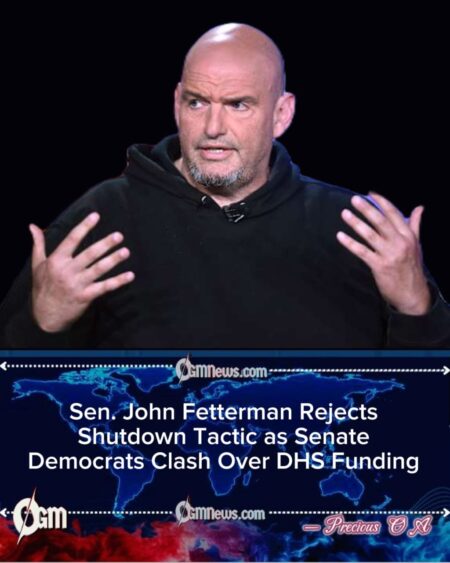
Sen. John Fetterman made clear this week that he will not support shutting down the federal government as a tactic to defund the Department of Homeland Security, signaling a firm stance as Senate Democrats debate their approach to an impending funding deadline. His comments came amid heightened pressure from some progressive voices urging lawmakers to use every available lever to force changes to immigration and border policy.
The funding deadline has sharpened tensions across Capitol Hill, with both parties maneuvering to avoid blame for any lapse in government operations. While disagreements over DHS policy remain intense, the prospect of a shutdown has raised concerns about economic disruption, federal worker furloughs, and interruptions to essential services.
Lawmakers from both parties have acknowledged that shutdown brinkmanship carries political and practical risks. As negotiations continue, the focus has shifted toward whether a short-term funding extension or a narrowly tailored compromise can keep the government open while broader policy disputes are addressed through regular legislative channels.
Senate Dynamics and Party Divisions
Sen. John Fetterman has positioned himself as a dissenting voice within his party on the question of shutdown tactics, arguing that withholding government funding could have unintended consequences for public safety and governance. His position underscores the ideological diversity within the Democratic caucus, particularly on strategy rather than policy goals.
Democratic leaders have sought to balance calls for accountability and reform with the realities of divided government. With slim margins and procedural constraints in the Senate, party leadership faces the challenge of unifying members around a path that can attract bipartisan support.
Procedural hurdles also loom large, as any funding bill must clear the Senate’s filibuster threshold. This reality has tempered expectations that sweeping policy changes could be attached to must-pass legislation without significant concessions or cross-party agreement.
Sen. John Fetterman and the Shutdown Debate
Sen. John Fetterman has framed his position as a pragmatic assessment of what shutdown politics achieve in practice. In remarks to colleagues and reporters, he emphasized that allowing the government to close would not guarantee policy victories and could instead erode public trust.
Sen. John Fetterman has also highlighted the impact a shutdown could have on federal employees and their families, noting that many workers would face uncertainty or financial strain. He argued that lawmakers have a responsibility to govern in a way that minimizes collateral harm while pursuing reforms through sustainable means.
Sen. John Fetterman further stressed that disagreements over DHS funding should be resolved through committee work, oversight, and targeted legislation. By separating policy debates from basic government operations, he suggested Congress could maintain stability while still engaging in rigorous scrutiny of executive agencies.
Implications for DHS Funding
Sen. John Fetterman reiterated that his opposition to a shutdown does not equate to unconditional support for current DHS policies. He maintained that oversight and reform remain necessary, but should be pursued without jeopardizing the continuity of government services.
DHS officials have warned that funding disruptions could affect border security operations, disaster response, and cybersecurity initiatives. Even a brief shutdown can delay projects and complicate coordination across federal, state, and local partners.
Budget analysts note that stopgap measures, while imperfect, often provide breathing room for negotiators. However, repeated reliance on temporary funding can create uncertainty for agencies tasked with long-term planning and resource allocation.
Reactions Across Capitol Hill
Sen. John Fetterman’s stance has drawn mixed reactions from colleagues. Some Democrats have praised his emphasis on stability, while others argue that extraordinary measures are sometimes necessary to force policy change in a polarized environment.
Republican senators, meanwhile, have pointed to Democratic divisions as evidence that shutdown threats lack unified support. Several GOP lawmakers have indicated they would consider targeted funding agreements if broader shutdown scenarios are taken off the table.
Advocacy groups on both sides of the immigration debate have weighed in, urging lawmakers to prioritize their respective policy goals. The split reactions reflect the broader national conversation about how Congress should balance leverage, responsibility, and governance.
Path Forward and Legislative Timelines
Sen. John Fetterman has encouraged colleagues to focus on achievable outcomes ahead of the funding deadline, suggesting that incremental progress is preferable to stalemate. His comments signal an openness to negotiation rather than confrontation.
Sen. John Fetterman also pointed to the Senate’s legislative calendar, noting that prolonged delays could crowd out other priorities, including economic legislation and national security measures. Keeping the government funded, he argued, allows Congress to address multiple challenges without distraction.
Looking ahead, lawmakers are expected to continue talks on a short-term funding extension while broader DHS-related debates proceed in parallel. As the deadline approaches, the emphasis remains on preventing a shutdown and finding a workable compromise that reflects the complex realities of divided government.



[…] […]