























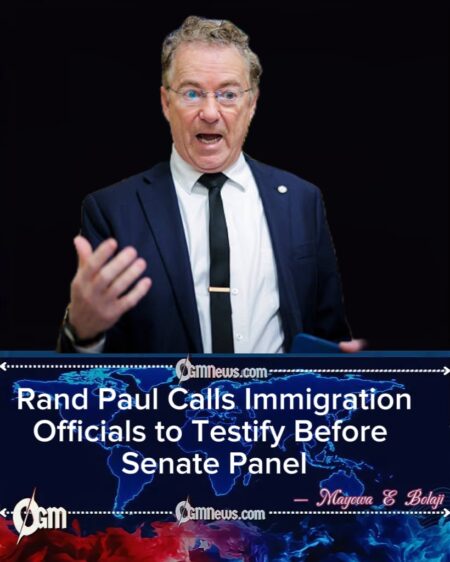
Senator Rand Paul, Chair of the Senate Homeland Security and Governmental Affairs Committee, has moved to place federal immigration enforcement under direct congressional scrutiny following the fatal shooting of a Minneapolis man by federal agents. By calling on three senior immigration enforcement officials to testify before his committee, Rand Paul has positioned himself at the center of a renewed debate over accountability, transparency, and the use of force in immigration operations.
The request comes amid rising political tension surrounding immigration policy and federal law enforcement tactics. While authorities maintain that the agents involved acted within the law, Rand Paul’s intervention signals that Congress intends to examine not just the incident itself, but the broader systems governing such operations.
Rand Paul’s Oversight Authority and Rationale
As committee chair, Rand Paul holds significant oversight authority over the Department of Homeland Security and its enforcement arms. In requesting testimony, he emphasized the Senate’s constitutional role in ensuring that federal agencies operate within legal and ethical boundaries, especially when an encounter results in a civilian death.
Paul’s approach, according to committee aides, is focused on fact-finding rather than assigning blame in advance. He has argued consistently that transparency protects both the public and law enforcement officers by ensuring that policies are clear and consistently applied.
The Minneapolis Shooting Under Review
The incident that prompted Rand Paul’s action occurred during a federal immigration enforcement operation in Minneapolis. Federal officials stated that the man killed was armed and that agents responded to an immediate threat. However, limited public disclosure following the shooting led to questions about how the situation escalated.
Rand Paul’s committee is expected to review the timeline of events, the decision-making process of agents on the ground, and whether existing rules of engagement were followed. The case has become a focal point in broader discussions about federal enforcement activities in major cities.
Immigration Enforcement Practices in Focus
Beyond the single incident, Rand Paul has signaled interest in examining immigration enforcement practices more broadly. This includes how agents conduct arrests, assess risk, and coordinate with local authorities in densely populated areas.
Lawmakers are expected to question whether current training standards adequately prepare agents for volatile encounters and whether policy guidance sufficiently emphasizes de-escalation. Paul has previously advocated for clear limits on federal power, making these issues central to the upcoming hearing.
Political and Public Response to Rand Paul’s Move
Rand Paul’s call for testimony has drawn mixed reactions across the political spectrum. Supporters view it as a necessary step to restore public trust and reinforce congressional oversight. Critics, however, argue that such hearings risk politicizing law enforcement actions before investigations are complete.
Public interest groups and civil liberties organizations have largely welcomed the move, seeing it as an opportunity to place verified information into the public domain. Others have cautioned that the committee must balance transparency with the need to protect ongoing investigations and agent safety.
Transparency, Data, and Public Trust
A central theme of Rand Paul’s inquiry is expected to be transparency. Analysts anticipate questions about data collection on agent-involved shootings, internal review processes, and how quickly information is shared with the public after critical incidents.
Paul has repeatedly argued that data-driven oversight strengthens democratic accountability. By demanding detailed explanations and documentation, he aims to reduce speculation and ensure that public debate is grounded in verified facts rather than political narratives.
What Comes Next
The Senate committee has yet to announce a formal hearing date, but preparations are underway. Following testimony, Rand Paul’s panel may issue findings, request further documentation, or recommend policy adjustments within immigration enforcement agencies.
While the outcome remains uncertain, Rand Paul’s decision to convene testimony underscores his intent to assert congressional oversight at a sensitive moment. The hearing is expected to shape not only the response to the Minneapolis shooting, but also future discussions on the balance between immigration enforcement, public safety, and civil liberties.
[…] […]