




























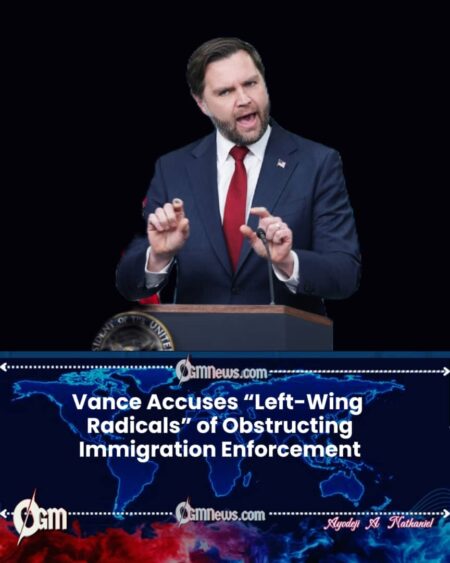
Senator JD Vance has ignited a renewed debate over immigration enforcement and political protest after asserting that organized activist groups are deliberately undermining the federal government’s ability to carry out immigration laws. Speaking in a sharply worded critique of media coverage, Vance argued that some opponents of current immigration policies have crossed from lawful dissent into tactics he described as “domestic terror,” language that has drawn both support and condemnation.
The comments come amid heightened national attention on border security and enforcement priorities under President Donald Trump, the current U.S. president serving a second term. As immigration remains one of the most polarizing issues in American politics, Vance’s remarks underscore widening disagreements over the legitimacy of protest, the role of the media, and the boundaries of political activism.
A Forceful Claim About Activism and Enforcement
Vance’s central claim is that a “group of left-wing radicals” is working “tirelessly” to prevent the federal government from enforcing immigration laws passed by Congress. According to the senator, these efforts are not isolated acts of protest but part of a sustained campaign aimed at disrupting the executive branch’s mandate.
He argued that such actions undermine the will of voters who elected the current administration with a clear expectation of stricter immigration enforcement. By framing the issue as one of democratic accountability, Vance positioned his remarks as a defense of electoral outcomes rather than a critique of dissent itself.
The Use of Charged Language
One of the most controversial aspects of Vance’s statement was his use of the phrase “domestic terror techniques.” Critics have said that the terminology risks inflaming tensions and blurring distinctions between violent extremism and nonviolent civil disobedience.
Supporters, however, contend that the language reflects frustration with tactics such as obstruction of federal operations or coordinated disruptions. They argue that Vance was calling attention to methods rather than labeling all opposition as extremist, though the wording has intensified scrutiny of his broader message.
Media Coverage and the Question of Truth
Vance also took aim at the news media, asserting that journalists should more explicitly report what he sees as organized attempts to thwart immigration enforcement. In his view, failure to do so amounts to an incomplete portrayal of the political landscape surrounding immigration.
Media analysts note that coverage of protests and enforcement actions often varies widely depending on editorial perspective. The debate raised by Vance’s comments highlights ongoing tensions between elected officials and journalists over framing, emphasis, and the interpretation of politically charged events.
Immigration Policy Under the Current Administration
Immigration enforcement has been a defining issue for President Trump’s second term, with the administration emphasizing border security, deportation efforts, and the application of existing laws. Officials have argued that these measures reflect campaign promises and voter expectations.
Opponents counter that enforcement policies have humanitarian and legal implications that warrant resistance and reform. This clash of priorities has fueled protests, court challenges, and legislative debates, setting the stage for statements like Vance’s to resonate strongly with partisan audiences.
Political Reactions and Public Response
Reaction to Vance’s remarks has been swift. Conservative allies have largely echoed his concerns, framing them as a necessary pushback against what they see as disruptive activism. Progressive leaders and advocacy groups, by contrast, have criticized the senator for rhetoric they say unfairly characterizes dissent and escalates political divisions.
Public opinion remains divided, reflecting broader polarization around immigration and protest. While some Americans prioritize strict enforcement, others emphasize civil liberties and the right to oppose government policy, ensuring that the debate sparked by Vance’s comments is unlikely to fade quickly.
Implications for the Ongoing Immigration Debate
The episode illustrates how immigration policy continues to serve as a flashpoint for broader questions about governance, protest, and media responsibility. By linking activism to the ability of an elected administration to govern, Vance has reframed the discussion in terms of institutional authority and democratic mandate.
As Congress, the White House, and advocacy groups continue to clash over immigration, the language used by political leaders will play a significant role in shaping public perception. Whether Vance’s remarks lead to substantive policy shifts or simply deepen rhetorical divides remains to be seen.
[…] […]