




























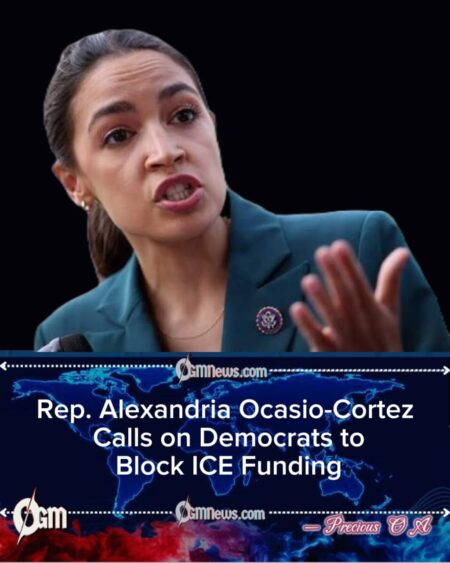
Rep. Alexandria Ocasio-Cortez publicly called on fellow Democrats to pursue legislative action aimed at blocking future federal funding for Immigration and Customs Enforcement, framing the proposal as a budgetary and oversight issue rather than a symbolic political gesture.
The New York lawmaker made the remarks during a broader discussion on immigration enforcement priorities, emphasizing Congress’s constitutional authority over federal spending and the role appropriations play in shaping executive branch operations.
Rep. Alexandria Ocasio-Cortez argued that lawmakers should use the appropriations process to impose stricter limits on enforcement agencies, contending that funding decisions offer one of the most direct tools available to lawmakers seeking accountability and policy change.
Legislative Strategy and Budget Mechanics
Efforts to restrict or block funding for a federal agency typically move through the appropriations committees in both chambers of Congress, where annual budget bills are drafted, amended, and negotiated with the executive branch.
Rep. Alexandria Ocasio-Cortez has previously supported using budget negotiations to advance policy goals, a strategy that can include reducing allocations, attaching conditions to spending, or declining to authorize funds for specific programs.
Such approaches often face procedural and political hurdles, including the need for majority support within the House and Senate, as well as the likelihood of a presidential veto if funding restrictions conflict with the administration’s priorities.
Internal Democratic Debate
Rep. Alexandria Ocasio-Cortez’s call highlights an ongoing debate within the Democratic Party over how aggressively to pursue changes to immigration enforcement, particularly in a divided Congress where margins are narrow.
Some Democrats support incremental reforms and enhanced oversight while maintaining baseline funding for enforcement agencies, arguing that abrupt funding cuts could create operational uncertainty and unintended consequences.
Rep. Alexandria Ocasio-Cortez and other progressive lawmakers counter that sustained pressure through fiscal controls is necessary to compel meaningful reform, especially when prior oversight measures have produced limited results.
Rep. Alexandria Ocasio-Cortez and Immigration Enforcement Oversight
Oversight of immigration enforcement has long been a focal point of congressional hearings, inspector general reports, and legislative proposals addressing detention conditions, use of force, and due process standards.
Rep. Alexandria Ocasio-Cortez has frequently pointed to these oversight findings as justification for a tougher congressional stance, arguing that funding decisions should reflect documented concerns rather than maintaining the status quo.
The broader oversight framework also involves coordination with the Department of Homeland Security, which oversees ICE, adding another layer of complexity to any effort to condition or withhold funding.
Republican Response and Institutional Constraints
Rep. Alexandria Ocasio-Cortez’s proposal has drawn criticism from Republican lawmakers, who argue that reducing ICE funding could undermine border security and federal law enforcement responsibilities.
Opponents also note that major funding changes would require bipartisan agreement or unified control of government, conditions that are often difficult to achieve in closely divided chambers.
Rep. Alexandria Ocasio-Cortez has acknowledged these constraints while maintaining that introducing the proposal itself helps define policy priorities and signals the direction some lawmakers believe the party should take.
Implications for Immigration Policy and Governance
Debates over ICE funding reflect broader tensions in U.S. immigration policy, where enforcement, humanitarian concerns, and legislative authority intersect in complex ways.
Rep. Alexandria Ocasio-Cortez’s stance underscores a growing willingness among some lawmakers to use fiscal tools as leverage in policy disputes, even when success is uncertain in the short term.
The outcome of such proposals may ultimately shape not only immigration enforcement practices but also how Congress exercises its spending power in future debates over federal agency accountability.


[…] […]