




























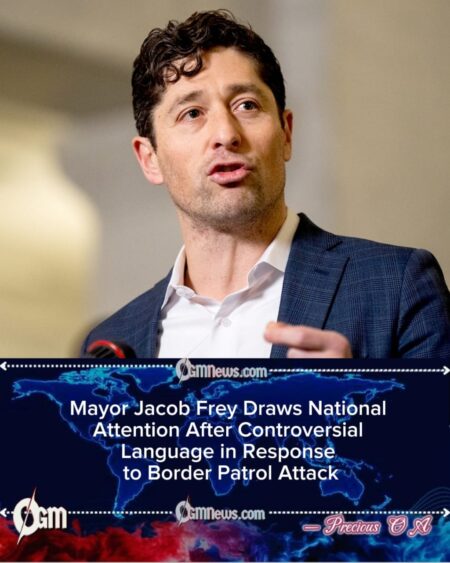
Mayor Jacob Frey opened the city’s response to a reported attack involving an armed individual and federal Border Patrol personnel by referring to the suspect as a “constituent,” a word choice that immediately drew public attention and criticism. His remarks were delivered amid heightened concern over public safety and political rhetoric.
Mayor Jacob Frey emphasized that his initial comments were meant to acknowledge jurisdictional responsibility rather than excuse violence, according to aides familiar with the exchange. Still, the phrasing circulated widely online, prompting debate about tone and accountability from elected officials.
Mayor Jacob Frey later expressed frustration as the reaction intensified, with critics arguing that the language appeared to minimize the seriousness of an alleged armed assault. Supporters, however, contended that the mayor was being misinterpreted in a charged political moment.
Details of the Incident and Law Enforcement Response
The incident itself involved an armed man who allegedly confronted or attacked Border Patrol personnel, triggering a rapid response from local and federal law enforcement. Authorities moved quickly to secure the scene and ensure that no further harm occurred.
Mayor Jacob Frey noted that Minneapolis officials were cooperating fully with federal agencies as the investigation continued. He stressed that any act of violence against law enforcement is taken seriously by city leadership, regardless of political context.
Mayor Jacob Frey also pointed to existing coordination protocols between city police and federal officers, stating that public safety operations require clear communication and mutual respect across jurisdictions.
Public Reaction and Political Fallout
Public reaction to the mayor’s comments was swift, with social media users, commentators, and political opponents questioning why the term “constituent” was used in reference to an alleged attacker. Many argued that such language risked blurring lines between civic representation and criminal accountability.
Mayor Jacob Frey became the focal point of the controversy as calls grew for clarification or retraction. Community members expressed concern that political language could unintentionally signal tolerance for violent behavior.
Some civic leaders urged restraint, arguing that early statements made during developing situations are often imperfect and should be evaluated alongside subsequent clarifications and actions.
Mayor Jacob Frey Responds to Escalating Criticism
Mayor Jacob Frey addressed the backlash directly in follow-up remarks, stating that his comments had been taken out of context and that he unequivocally condemns violence against law enforcement officers. He underscored that the safety of residents and officers remains his top priority.
City hall sources indicated that the mayor’s visible anger stemmed from what he viewed as deliberate mischaracterization of his words. He reportedly expressed concern that the focus on phrasing was overshadowing the seriousness of the alleged crime itself.
Mayor Jacob Frey reiterated that describing someone as a constituent does not imply endorsement, sympathy, or diminished legal responsibility, but rather reflects the reality that elected officials represent all residents within their jurisdiction.
Broader Debate Over Language and Leadership
Mayor Jacob Frey’s remarks have fed into a broader debate about how political leaders communicate during crises involving violence and federal agencies. Analysts note that word choice can significantly shape public perception, especially in polarized environments.
Critics argue that leaders must exercise heightened caution, as even neutral terminology can be perceived as political signaling. Supporters counter that expecting perfectly calibrated language in real time is unrealistic.
The episode has reignited discussion about whether officials should delay public comment until full details are known, or whether immediate transparency, even if imperfect, better serves public trust.
Implications for Public Trust and Governance
Mayor Jacob Frey acknowledged that maintaining public confidence requires not only firm action but also clear communication. He stated that future briefings would focus more explicitly on condemning violence and outlining concrete steps taken by authorities.
Observers say the controversy may influence how city leaders approach statements involving federal law enforcement, immigration issues, and politically sensitive crimes going forward. The balance between representation and condemnation remains a delicate one.
As the investigation continues, attention is expected to shift back to legal proceedings and security assessments, while the debate over rhetoric serves as a reminder of the scrutiny faced by public officials during moments of crisis.


[…] […]