























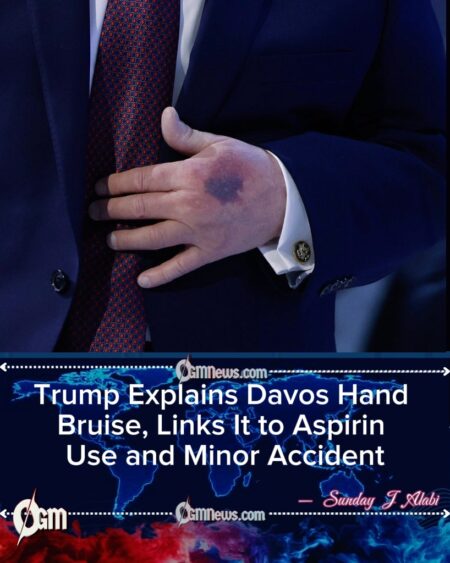
President Donald Trump has offered a detailed explanation for a noticeable bruise on his left hand, dismissing health concerns while reaffirming confidence in his physical condition and political future. Speaking to reporters after an international appearance in Switzerland, the U.S. president attributed the injury to a minor accident, linked it to his long-standing aspirin use, and used the moment to reflect on what he described as strong progress during his second term in office.
The remarks, delivered casually aboard Air Force One, quickly drew public attention not only because of the visible contusion but also because Trump again alluded to the possibility of extending his time in power beyond constitutional limits. While the comments were framed rhetorically, they have added to ongoing discussions around the president’s health, age, and political intentions.
A Bruise That Sparked Public Attention
The purple bruise on President Trump’s left hand was first observed during the Board of Peace signing ceremony in Davos, Switzerland. Photographs from the event suggested that the discoloration was not present at the beginning of the ceremony but appeared later, prompting speculation both online and in political circles.
Addressing the matter directly, Trump said he had “clipped” his hand on a table during the event. He described the incident as painful but minor, noting that he applied a topical cream and continued with his schedule. According to the president, the injury was not serious and did not affect his ability to carry out official duties.
The White House did not issue a formal medical statement, but Trump’s own explanation was delivered with characteristic informality, reinforcing his message that there was no cause for alarm.
Aspirin Use and the President Trump’s Explanation
Beyond the accidental knock, President Trump pointed to his daily aspirin regimen as a contributing factor to the severity of the bruise. He told reporters that he takes what he described as a “big aspirin,” explaining that higher doses are known to increase bruising.
Trump framed the issue as a trade-off, suggesting that while aspirin may lead to visible bruises, he believes it benefits heart health by thinning the blood. He said doctors had previously told him he could reduce or stop the medication, but he chose not to “take any chances.”
Medical experts generally note that aspirin can indeed increase bruising by slowing the blood’s ability to clot. However, they also caution that higher doses, particularly in older adults, can raise the risk of internal bleeding.
Medical History and Known Health Factors
The president Trump has previously acknowledged that he bruises easily, a tendency he has attributed to aspirin use over many years. He has said he has been taking approximately 325 milligrams daily for more than two decades, despite doctors encouraging a lower dosage.
Trump has also been diagnosed with chronic venous insufficiency, a circulatory condition that can increase swelling and bruising in the limbs. At one point, the condition led him to wear compression socks, though he later stopped using them, reportedly because he disliked them.
Despite these factors, Trump has consistently portrayed himself as healthy, often citing what he calls “good genetics” and emphasizing his personal confidence over medical caution.
Age, Visibility, and the Demands of Office
At 79, President Trump is the oldest individual to be elected and serve as U.S. president. His health and stamina have therefore been subject to heightened scrutiny, with even minor physical signs, such as bruising, attracting outsized attention.
In the past, Trump’s right hand has frequently appeared bruised and covered with makeup. White House Press Secretary Karoline Leavitt has said this was due to the president’s frequent handshaking during public engagements, rather than any underlying medical issue.
The appearance of the bruise on Trump’s left hand—an area not typically concealed—added to public curiosity, underscoring how visible markers can quickly become political talking points in the modern media environment.
Confidence in Health and Leadership
Throughout his remarks, Trump struck an unconcerned tone about his condition. He emphasized that he felt “very good” and dismissed the bruise as an expected side effect of medication combined with a minor accident.
The president’s comments reflected a broader pattern in his public communication: downplaying physical vulnerabilities while projecting strength and resilience. This approach has long been central to his political persona and messaging.
By addressing the bruise directly, Trump appeared intent on controlling the narrative and preventing speculation from overshadowing his policy agenda and international engagements.
Hints at a ‘Fourth Term’ and Political Implications
While discussing his health and second-term achievements, Trump again raised eyebrows by rhetorically suggesting a “fourth term” as president. The remark followed his praise of what he described as record-setting progress during his current administration.
Under the U.S. Constitution, presidents are limited to two four-year terms. Trump has previously teased the idea of running again in 2028, despite these restrictions, often framing such comments as hypothetical or provocative.
Though no formal plan has been announced, the repeated references continue to energize supporters while drawing criticism and concern from constitutional scholars and political opponents.
For now, the White House has treated the incident as a non-issue, and President Trump has shown no indication of altering his schedule or medical routine. The episode, however, illustrates how even minor physical details can become entwined with broader debates about leadership, longevity, and power.
As Trump continues his second term, scrutiny of his health and statements about the future are likely to remain a recurring feature of public discourse—particularly as he continues to blur the line between casual remarks and consequential political signals.
[…] […]