

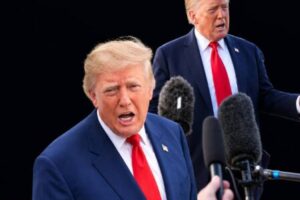




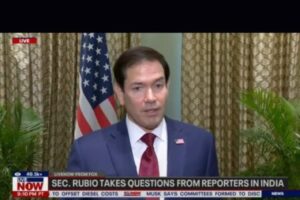






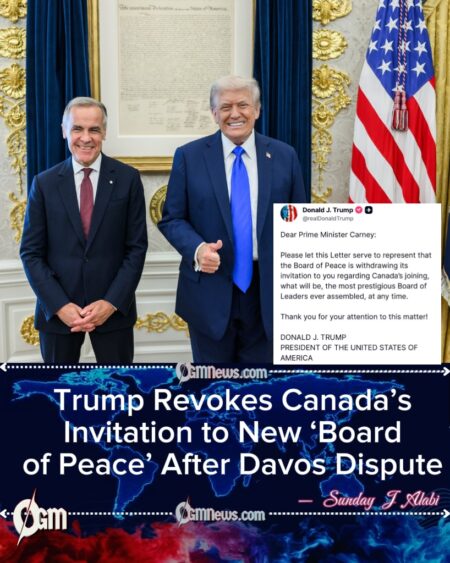
A diplomatic rift emerged this week after U.S. President Donald Trump, currently serving his second term, announced that Canada’s prime minister, Mark Carney, was no longer invited to join a newly unveiled international body known as the “Board of Peace.” The withdrawal, communicated via Trump’s social media account and reportedly posted from Air Force One, followed public disagreements between the two leaders during and after the World Economic Forum in Davos, Switzerland. The episode has drawn attention to broader tensions over global governance, financing, and the future of U.S.-led international initiatives.
A Public Withdrawal Announced Online
President Trump’s message to Prime Minister Carney was delivered in the form of a formal but pointed social media post, framed as a letter. In it, Trump stated that the Board of Peace was rescinding Canada’s invitation to join what he described as “the most prestigious Board of Leaders ever assembled.” The post indicated that the withdrawal applied indefinitely and left little room for reinterpretation.
The public nature of the announcement underscored Trump’s preference for direct communication through his own platform, a style that has characterized much of his second-term diplomacy. While the White House did not immediately issue a separate official statement, the message itself was treated as authoritative by U.S. officials.
The ‘Board of Peace’ and Its Ambitions
The Board of Peace was introduced by President Trump at Davos with considerable publicity. Initially described as a temporary body, its stated purpose was to oversee governance and reconstruction efforts in Gaza, with the potential to evolve into a broader international forum. Membership, however, came with a proposed financial commitment of $1 billion for a permanent seat.
Several leaders of liberal democracies declined to participate from the outset, citing concerns about structure, mandate, and financing. Canada, under Prime Minister Carney, had taken a more cautious position, agreeing in principle while emphasizing the need for further review.
Canada’s Conditional Acceptance and Financial Concerns
Before the Davos meetings, Prime Minister Carney indicated that Canada was open to engaging with the Board of Peace but had not finalized its position. He noted that Canadian officials still needed to examine “all the details of the structure, how it’s going to work, what the financing is for.”
This caution was reinforced by Canada’s finance minister, François-Philippe Champagne, who later confirmed that Ottawa did not plan to pay the $1 billion contribution requested for permanent membership. Champagne’s remarks suggested that Canada viewed the financial expectations as inconsistent with the board’s original, temporary description.
Davos Speeches Highlight Deeper Differences
Tensions escalated during the Davos forum itself. In a widely discussed address, Prime Minister Carney spoke of what he termed “a rupture” in the previously U.S.-led, rules-based international order. He attributed this shift to increasingly aggressive American behavior on the global stage, comments that were interpreted as a direct critique of President Trump’s foreign policy approach.
President Trump responded the following day in his own Davos speech, making pointed remarks about Canada’s reliance on the United States. “Canada lives because of the United States,” he said, addressing Carney by name and signaling that he was aware of the Canadian leader’s earlier comments.
Exchange of Sharp Words Between Leaders
Prime Minister Carney did not leave Trump’s remarks unanswered. Speaking on Thursday, he rejected the characterization outright. “Canada doesn’t live because of the United States,” Carney said. “Canada thrives because we are Canadian.” The statement was widely circulated and interpreted as a defense of Canadian sovereignty and independence.
The exchange highlighted contrasting national narratives and leadership styles. While Trump emphasized U.S. leverage and influence, Carney focused on Canada’s autonomy and economic resilience, setting the stage for the subsequent withdrawal of the board invitation.
Implications for U.S.–Canada Relations
Although both governments have stopped short of describing the episode as a formal diplomatic crisis, the incident adds strain to an already complex bilateral relationship. Cooperation between the two countries remains extensive in trade, security, and regional issues, but public disagreements at the leadership level risk complicating coordination on multilateral initiatives.
Analysts note that the Board of Peace controversy reflects broader questions about how international cooperation is structured and financed in Trump’s second term. Whether the dispute will have lasting effects may depend on future engagement behind closed doors rather than public exchanges.


Logging in is a breeze and the site stability is amazing even during peak hours....