





















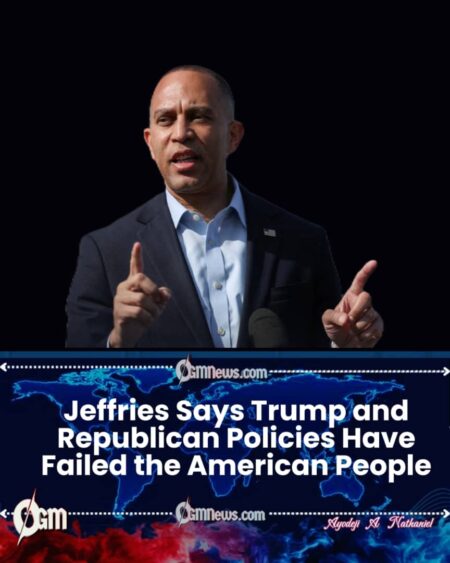
House Democratic Leader Hakeem Jeffries has delivered a sharp rebuke of President Donald Trump and the Republican Party, declaring that their policies amount to “a complete and total failure” for the American people. Speaking as debates over the economy, governance, and national priorities intensify, Jeffries argued that Republican leadership remains disconnected from the everyday concerns of citizens.
His comments reflect a broader Democratic strategy aimed at framing the political landscape ahead of key legislative battles and upcoming elections. Jeffries positioned his criticism as a judgment not just on rhetoric, but on policy outcomes that he said have negatively affected households across the country.
Jeffries’ Assessment of Republican Governance
Jeffries said the record of President Donald Trump, the current U.S. president serving a second term, and congressional Republicans demonstrates what he described as a pattern of misaligned priorities. According to him, Republican leadership has failed to deliver meaningful improvements in economic security, healthcare affordability, and public trust in government.
He argued that the consequences of these policies are visible in rising costs, persistent inequality, and institutional instability. Jeffries framed his remarks as a verdict based on lived experiences rather than partisan theory.
Democratic aides say the message is intended to resonate with voters who feel frustrated by political gridlock and unmet promises.
Criticism of Republican Priorities
A central theme of Jeffries’ remarks was his claim that Republicans are “focused on all the wrong things.” He accused the party of prioritizing ideological battles and political grievances over pragmatic solutions to pressing national challenges.
Jeffries said issues such as economic relief, infrastructure investment, and social stability have taken a back seat to partisan agendas. In his view, this approach has weakened public confidence in Washington’s ability to govern effectively.
Republican leaders, for their part, argue that their policies emphasize fiscal discipline, border security, and national strength, rejecting the notion that their focus is misplaced.
Policy Outcomes Under Scrutiny
Jeffries pointed to policy outcomes as evidence for his criticism, arguing that Republican-led initiatives have failed to deliver broad-based benefits. He cited concerns over cost-of-living pressures and access to essential services as indicators that current policies are not working for most Americans.
Democrats say these issues underscore the need for an alternative governing vision centered on economic opportunity and social investment. Jeffries framed the debate as one between governance that serves the many versus policies that benefit a narrow set of interests.
Analysts note that such framing is consistent with long-standing Democratic messaging on economic fairness and accountability.
Democratic Strategy and Political Context
Jeffries’ statement comes as Democrats seek to sharpen contrasts with Republicans ahead of legislative showdowns and electoral contests. Party leaders are increasingly using direct language to define the stakes for voters.
Within Democratic circles, Jeffries is seen as consolidating his role as a chief national spokesperson, articulating critiques that unify the party’s base while appealing to undecided voters. His remarks align with broader efforts to present Democrats as focused on results rather than rhetoric.
Political observers say the intensity of the language reflects heightened polarization and a belief that clarity, rather than caution, now drives political communication.
Republican Response and Ongoing Debate
Republicans have dismissed Democratic criticism as partisan attacks, arguing that their policy agenda addresses long-term national challenges. Supporters of President Trump say his administration’s approach prioritizes economic nationalism, law enforcement, and American sovereignty.
The exchange underscores the deep divisions shaping U.S. politics, with each side presenting starkly different interpretations of recent policy outcomes. As debates continue, both parties appear determined to frame the narrative ahead of future elections.
For now, Jeffries’ comments add to an increasingly confrontational political climate, where assessments of success and failure depend largely on partisan perspective.


[…] […]