






















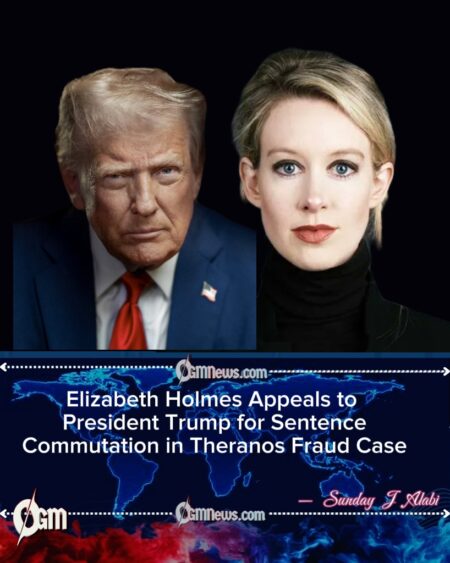
Theranos founder Elizabeth Holmes has formally asked U.S. President Donald Trump to commute her prison sentence, according to records on the U.S. Department of Justice website, reopening debate around one of Silicon Valley’s most notorious corporate fraud cases
A High-Profile Petition for Clemency by Elizabeth Holmes
Elizabeth Holmes, the founder and former chief executive of the now-defunct blood-testing company Theranos, has submitted a formal request to President Donald Trump asking for a commutation of her federal prison sentence. The request, filed last year, is listed as “pending” on the U.S. Department of Justice’s Office of the Pardon Attorney website, indicating it is under official consideration.
The White House has not publicly commented on the petition, and there has been no indication of whether the president intends to act on the request. Still, the filing confirms that Holmes is seeking relief from a sentence that followed years of legal battles and intense public scrutiny.
Holmes, once celebrated as a visionary entrepreneur, was sentenced in November 2022 to more than 11 years in prison after being convicted on four counts of defrauding investors. Her appeal to presidential clemency marks a significant development in a case that came to symbolize excess, deception, and unchecked hype in the technology sector.
From Silicon Valley Prodigy to Convicted Fraudster
Holmes founded Theranos with the promise of transforming medical diagnostics through technology capable of performing a wide range of tests using just a pinprick of blood. The company’s claims attracted enormous attention and investment, pushing its valuation to an estimated $9 billion at its peak.
Despite having no formal medical training and leaving university before completing her degree, Holmes convinced regulators, investors, and influential figures that Theranos had achieved a breakthrough in healthcare diagnostics. Her image—defined by black turtlenecks and confident public appearances—became synonymous with disruptive innovation in Silicon Valley.
However, federal prosecutors later argued that the company’s technology never worked as advertised. Holmes was found guilty of misleading investors about the capabilities and readiness of Theranos’s testing systems, a deception that ultimately led to the company’s collapse.
The Role of Powerful Backers and Public Trust
Theranos’s rise was fueled not only by bold claims but also by the endorsement of prominent individuals. Among those persuaded by Holmes’s vision were media magnate Rupert Murdoch, former U.S. Secretary of State Henry Kissinger, and Oracle co-founder Larry Ellison. Their backing lent the company credibility and helped shield it from early skepticism.
The trust placed in Holmes extended beyond investors to the broader public, as Theranos positioned itself as a company capable of revolutionizing patient care. The promise of faster, cheaper, and less invasive blood testing resonated widely, particularly in an industry often criticized for high costs and slow innovation.
This widespread confidence made the eventual revelations more damaging. Prosecutors maintained that false assurances about the technology’s effectiveness not only misled investors but also risked patient safety, raising ethical concerns alongside financial ones.
Investigative Journalism and the Collapse of Theranos
The unraveling of Theranos began in 2015 with a series of investigative reports by Wall Street Journal journalist John Carreyrou. His reporting revealed that the company’s proprietary machines were not being used for most blood analyses and that conventional laboratory equipment performed the bulk of the testing.
As scrutiny intensified, regulators launched investigations into the company’s practices. Theranos eventually began retracting tests and recalling its machines, undermining its central claims and eroding investor confidence. The company’s credibility deteriorated rapidly as additional details emerged.
In June 2018, Holmes stepped down as chief executive, and Theranos was dissolved shortly afterward. That same year, federal authorities charged Holmes and her former business partner, Sunny Balwani, with defrauding investors and patients, setting the stage for one of the most closely watched corporate fraud trials in recent U.S. history.
Sentencing, Clemency, and Presidential Powers
Holmes’s conviction in 2022 resulted in a sentence of more than 11 years in federal prison, reflecting the scale of the fraud and the losses suffered by investors. Her request for a commutation seeks a reduction of that sentence rather than a full pardon, which would erase the conviction.
President Donald Trump, currently serving a second term, has made extensive use of his clemency powers. Since beginning his second term, he has granted clemency to more than 1,600 individuals, the majority connected to the January 6 attack on the U.S. Capitol. During his first term, by contrast, he issued just 237 pardons and commutations.
Whether Holmes’s petition will be viewed within this broader context remains unclear. Her case differs significantly from those that have dominated recent clemency decisions, and any action would likely reignite debate over accountability, white-collar crime, and the limits of presidential mercy.

[…] […]