


























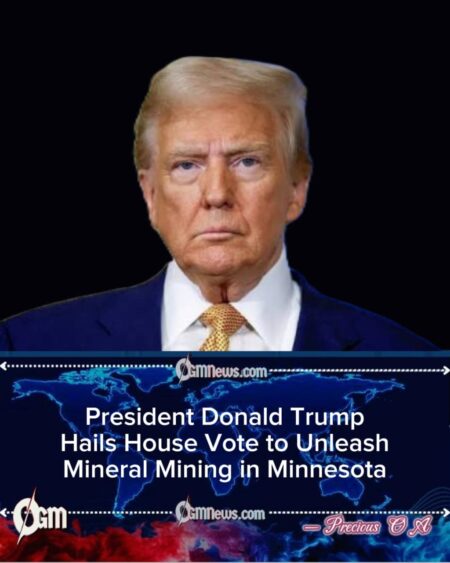
President Donald Trump celebrated what allies described as a major legislative victory after the U.S. House of Representatives voted 214–208 to overturn a Biden-era land management rule that restricted mineral mining on large portions of federal land in Minnesota. The vote clears the way for expanded exploration and extraction of critical minerals seen as essential to domestic manufacturing, energy independence, and national security.
President Donald Trump framed the House action as a decisive step toward restoring what he has long called “America-first resource policy.” Supporters argue the overturned rule had slowed investment, delayed permits, and discouraged companies from developing mineral resources that could reduce reliance on foreign suppliers.
The narrow margin of the vote reflected deep partisan divisions over environmental protection and industrial expansion. While Republicans largely backed the measure, Democrats warned that rolling back land safeguards could threaten ecosystems, water sources, and tribal lands across northern Minnesota.
Background of the Minnesota Land Rule
President Donald Trump had frequently criticized the Biden-era rule during his campaign, describing it as an example of overregulation that prioritized ideology over economic growth. The rule limited mining activity in sensitive areas near wilderness regions and watersheds, drawing praise from environmental groups but criticism from industry leaders.
The policy was introduced as part of a broader federal effort to balance mineral extraction with conservation. Supporters said it was designed to protect long-term ecological health while still allowing carefully managed development in designated zones.
Opponents, however, argued that the restrictions went too far. Mining advocates in Minnesota claimed the rule effectively froze projects that could have created jobs and boosted local economies already struggling with declining industries.
President Donald Trump’s Role in the Debate
President Donald Trump personally lobbied lawmakers in the lead-up to the House vote, according to several congressional aides. He emphasized the strategic importance of domestic mineral production, particularly for materials used in defense systems, electric vehicles, and advanced manufacturing.
President Donald Trump also highlighted Minnesota’s potential as a key supplier of nickel, copper, and other critical minerals. In public remarks, he argued that the United States should not depend on adversarial nations for resources that can be responsibly mined at home.
The former president’s involvement energized Republican lawmakers, many of whom credited his advocacy with helping secure the narrow majority needed to pass the measure.
Economic Implications for Minnesota
President Donald Trump and his allies say the House vote could unlock billions of dollars in investment across Minnesota’s mining regions. Proponents estimate that expanded mining could create thousands of direct and indirect jobs, from equipment manufacturing to transportation and processing.
Local officials in mining-adjacent communities welcomed the decision, saying it offers renewed hope for economic revitalization. Some counties have faced population decline and reduced tax bases as traditional industries have faded.
Environmental groups counter that economic gains may be overstated, warning that cleanup costs and long-term environmental damage could outweigh short-term benefits if mining is not strictly regulated.
Environmental and Tribal Concerns
President Donald Trump has dismissed claims that expanded mining necessarily means environmental harm, arguing that modern technology allows for safer and cleaner extraction. He has called for “smart development” that balances growth with stewardship.
Tribal leaders in Minnesota expressed concern following the House vote, noting that some proposed mining areas are near lands of cultural and historical significance. They urged federal agencies to continue consultation processes despite the rule’s repeal.
Environmental advocates vowed to challenge future permits, signaling that legal and regulatory battles are likely to continue even after the House action.
What Comes Next
President Donald Trump praised the House vote as a momentum-building win but acknowledged that further hurdles remain. The measure must still clear the Senate, where the margin is expected to be even tighter.
President Donald Trump suggested that continued public pressure could influence undecided senators, framing the issue as one of economic security and national resilience rather than partisan politics.
As the debate moves forward, the Minnesota mining decision is shaping up to be a defining test of how the United States balances environmental priorities with the demand for critical resources in an increasingly competitive global landscape.


[…] […]