
























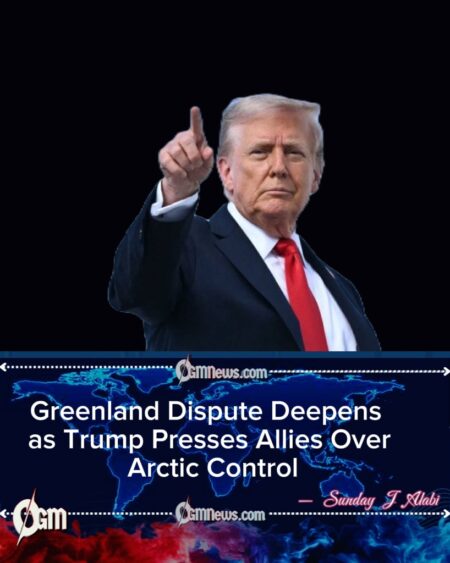
President Trump, serving a second term as U.S. president, has sharply escalated a diplomatic standoff with America’s European allies over Greenland, tying his renewed push for U.S. control of the Arctic island to his dissatisfaction with this year’s Nobel Peace Prize decision. The dispute has exposed deep fractures within NATO, raised concerns about the use of economic pressure against allies, and prompted renewed debate about sovereignty, security, and the future of Arctic cooperation.
At the centre of the controversy is a message sent by President Trump to Norway’s Prime Minister Jonas Gahr Støre and shared with other NATO leaders, in which he suggested that being passed over for the Nobel Peace Prize has altered his approach to international relations. In the same communication, the president restated his belief that only full U.S. control of Greenland can guarantee global security, while leaving open the possibility of military force.
A Nobel Peace Prize Dispute Fuels Diplomatic Tension
In his message to Norway’s leader, President Trump explicitly linked his stance on Greenland to the Nobel Peace Prize, stating that the decision to honour someone else relieved him of any obligation to “think purely of Peace.” He added that he was now free to focus solely on what he considers the best interests of the United States.
The message was notable not only for its tone but also for its timing. It came as European allies were already engaged in discussions with Washington over proposed tariff increases and broader transatlantic economic relations. By invoking the Nobel Prize in this context, President Trump introduced a personal grievance into an already sensitive geopolitical debate.
Norwegian officials later clarified that the Nobel Peace Prize is awarded by an independent committee and not by the Norwegian government. Prime Minister Støre said this had been clearly explained to President Trump, underscoring that Oslo has no political role in the decision-making process.
Renewed Claims Over Greenland by Trump Administration and U.S. Security
President Trump’s message reiterated his long-standing argument that Greenland is essential to U.S. and global security, citing concerns about potential Chinese and Russian influence in the Arctic. He claimed that without “complete and total control” by the United States, the world would remain unsafe.
These assertions have been widely rejected by NATO allies and by U.S. lawmakers from both major political parties. Critics point out that Greenland, as a territory of Denmark, already falls under NATO’s collective defence umbrella and has hosted U.S. military installations since World War II.
Denmark has also made clear that it is open to strengthening the U.S. defence presence on the island in cooperation with allies, a position intended to address growing strategic competition in the Arctic without altering sovereignty. Despite these assurances, President Trump has continued to argue that Denmark is incapable of protecting the territory.
Denmark, History, and Greenlandic Self-Determination
In questioning Denmark’s claim to Greenland, President Trump argued that Danish sovereignty rests on historical circumstances similar to those of other seafaring nations. However, historians note that Denmark became the colonial power in Greenland in the early 18th century, decades before the United States existed as an independent nation.
Greenland remained a Danish colony until 1953, when it transitioned to its current status of semi-autonomy within the Kingdom of Denmark. Today, the island has its own elected government and significant control over domestic affairs.
Crucially, Greenland’s population of about 60,000 people has repeatedly expressed opposition to becoming part of the United States. Greenlandic leaders have emphasised that any decision about the island’s future must be made by its residents, a position strongly supported by Denmark and other European governments.
Norway and Nordic Allies Push Back
Prime Minister Støre confirmed that he received President Trump’s message after sending a joint text with Finland’s President Alexander Stubb. The initial communication from the Nordic leaders had focused on opposing proposed U.S. tariff increases and calling for de-escalation through dialogue.
In his public response, Støre reaffirmed Norway’s position that Greenland is part of the Kingdom of Denmark and that Oslo fully supports Copenhagen on the issue. He also stressed the importance of NATO taking responsible steps to enhance Arctic security collectively.
Norway’s statement highlighted broader concern among European allies that linking trade threats and territorial demands undermines trust within the alliance. Officials warned that such tactics risk escalating tensions at a time when unity is seen as essential in addressing global security challenges.
Tariff Threats and Alliance Strain
President Trump’s suggestion that the United States could impose new tariffs on Denmark and several other European countries if they continue to reject his Greenland proposal has intensified unease within NATO. Eight European nations issued a joint statement reaffirming their commitment to Arctic security while condemning the use of economic pressure among allies.
The statement warned that tariff threats undermine transatlantic relations and could trigger a damaging cycle of retaliation. It also emphasised that discussions about Greenland’s security must respect sovereignty and territorial integrity.
While the White House has defended the president’s position, stating that Greenland is strategically vital and that its residents would be better protected by the United States, European leaders have largely viewed the approach as counterproductive.
The U.K. Urges Calm and Respect for Principles
British Prime Minister Keir Starmer, who has maintained working relations with President Trump, sought to strike a conciliatory but firm tone. Acknowledging the growing strategic importance of the Arctic, Starmer said the region would require greater investment and stronger collective defence, with the United States playing a central role.
However, he stressed that decisions about Greenland’s future belong solely to the people of Greenland and the Kingdom of Denmark. Starmer warned that using tariffs against allies is the wrong way to resolve disputes and risks harming the very alliances that underpin global stability.
Addressing President Trump’s refusal to rule out military action, Starmer said he did not believe it would come to that. He expressed confidence that the issue could be resolved through calm discussion grounded in respect for sovereignty and partnership, principles he described as essential to enduring alliances.
Casinoabc999? Good Site. The interface is sleek, and there is a lot of stuff to...