























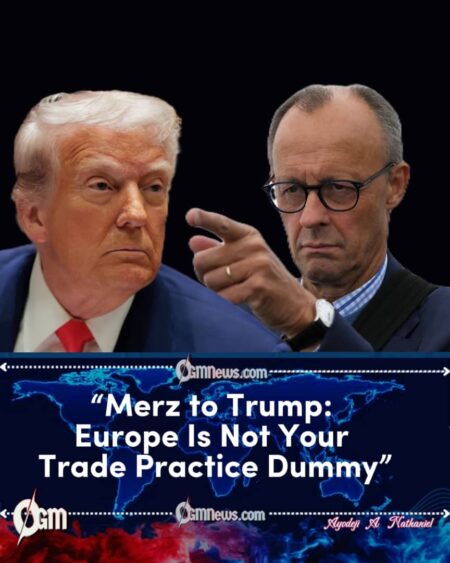
Friedrich Merz has delivered his most expansive warning yet to Donald Trump, cautioning that Europe is fully prepared to respond if U.S. trade and tariff policies continue to pressure European economies. Speaking against the backdrop of renewed tariff debates and uneven global growth, Merz said Europe seeks cooperation but will not hesitate to defend its economic and strategic interests.
The statement signals a potentially consequential moment in U.S.–European relations. While security cooperation remains strong, economic policy—particularly tariffs—has emerged as a central source of friction, with implications for global markets, supply chains, and diplomatic trust.
Merz Frames Europe’s Position: Cooperation First, Retaliation if Necessary
At the core of Friedrich Merz’s remarks was an attempt to strike a careful balance. He emphasized that Europe does not desire a trade confrontation with Washington and prefers negotiated solutions that preserve stability in global commerce. However, he made clear that restraint should not be mistaken for weakness.
Merz noted that Europe possesses significant economic leverage and regulatory tools. If U.S. policies threaten European industries, the response would be coordinated, lawful, and proportionate. His message was directed not only at Washington but also at European audiences, signaling readiness to protect jobs, exports, and long-term competitiveness.
President Donald Trump’s Trade Doctrine Under European Scrutiny
The warning comes as President Donald Trump, now serving a second term, continues to defend tariffs as a cornerstone of his economic and national security strategy. The Trump administration has argued that tariffs incentivize domestic production, reduce dependence on foreign supply chains, and strengthen negotiating power abroad.
European leaders, including Merz, dispute that assessment. They argue that tariffs often raise costs for consumers and businesses while inviting retaliatory measures that damage exporters on both sides of the Atlantic. The disagreement reflects a fundamental divide between Washington and European capitals over how best to manage globalization.
U.S. Economic Performance and the Tariff Debate
A notable element of Merz’s statement was his direct critique of U.S. economic outcomes. He argued that American growth has fallen short of expectations outlined a year earlier and suggested that tariff policy is partly responsible. According to Merz, uncertainty created by trade disputes discourages investment and distorts markets.
The Trump administration counters that investment commitments and employment figures demonstrate economic resilience. This clash of narratives underscores how economic data is being interpreted differently, fueling policy disagreements rather than resolving them.
Germany’s Exposure and Strategic Concerns
For Germany, the stakes are particularly high. As Europe’s largest economy and a global export powerhouse, Germany is deeply embedded in international supply chains. Merz stressed that German manufacturing, automotive exports, and advanced industrial sectors are vulnerable to prolonged trade friction.
He also highlighted the political dimension at home, noting that economic instability abroad can quickly translate into domestic pressure. Protecting Germany’s economic base, Merz said, is inseparable from maintaining social stability and public confidence.
The European Union’s Collective Approach
Merz underscored that any response would be coordinated through the European Union, reinforcing the bloc’s role as a unified economic actor. He rejected the idea of fragmented national responses, arguing that unity strengthens Europe’s negotiating position and credibility.
EU officials have increasingly emphasized “strategic autonomy,” aiming to reduce vulnerability to external shocks while remaining open to trade. Merz’s comments align with this broader European effort to balance openness with resilience.
Broader Implications for Global Markets and Alliances
The exchange between Merz and President Donald Trump has implications beyond Europe and the United States. Global markets are sensitive to signals of escalating trade conflict, and investors closely watch transatlantic relations as a bellwether for economic stability.
Analysts warn that sustained tension could ripple through financial markets, disrupt supply chains, and complicate cooperation on issues such as climate policy, technology standards, and security. While dialogue remains possible, Merz’s warning suggests Europe is preparing for a more assertive stance if talks fail.
[…] […]