





























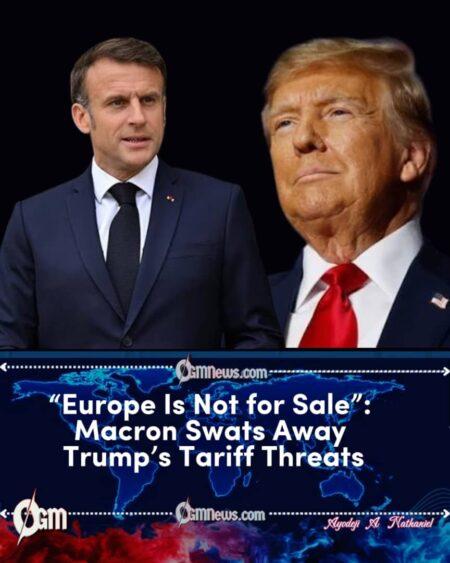
French President Emmanuel Macron has issued a firm response to U.S. pressure over Greenland, declaring that Europe will not yield to intimidation or economic threats. His remarks come after President Donald Trump, currently serving a second term as U.S. president, warned that tariffs on European goods would rise to 25 percent if Greenland is not sold to the United States by June 1, 2026.
Speaking on Europe’s strategic posture, Macron said that “no intimidation or threat will influence us, whether in Ukraine, in Greenland or anywhere else in the world,” adding that tariff threats are unacceptable. He stressed that Europe would respond in a united and coordinated manner to defend its sovereignty, signaling a hardened European stance as transatlantic tensions escalate.
Macron Draws a Red Line on Sovereignty and Pressure
President Macron’s comments underscore growing European resistance to what officials describe as coercive diplomacy. By explicitly linking Greenland and Ukraine, Macron framed the issue as part of a broader struggle over sovereignty, territorial integrity, and Europe’s right to make independent decisions free from external pressure.
French officials say the message is aimed not only at Washington but also at reassuring European partners that core principles will not be compromised for economic convenience. The language marks one of Macron’s strongest public rebukes of U.S. trade-linked geopolitical demands in recent years.
Diplomats in Paris note that the emphasis on unity is deliberate, reflecting concern that fragmented responses could weaken Europe’s negotiating position.
President Donald Trump and the Escalation of Tariff Pressure
President Donald Trump has tied the proposed acquisition of Greenland to a clear economic ultimatum, warning that failure to complete a sale by June 2026 would trigger higher tariffs on European exports. The approach reflects a broader policy pattern in which trade measures are used to pursue strategic and political objectives.
U.S. officials argue that Greenland’s Arctic location, natural resources, and security value justify a more assertive stance. They maintain that tariffs are a legitimate tool to protect U.S. interests and compel serious engagement from allies.
However, critics on both sides of the Atlantic argue that linking trade penalties to territorial issues risks destabilizing long-standing alliances and undermining established diplomatic norms.
Europe’s United Front on Greenland
European leaders have consistently stated that Greenland, an autonomous territory within the Kingdom of Denmark, is not for sale. Any change in its status would require the consent of its people, a point repeatedly emphasized by Copenhagen and Brussels.
Macron’s intervention reinforces this position by elevating the dispute from a bilateral disagreement into a collective European concern. EU officials say discussions are underway to ensure a coordinated response should the U.S. proceed with tariff increases.
The emphasis on unity reflects lessons from past trade disputes, where divided responses reduced Europe’s leverage in negotiations with Washington.
Trade Risks and Economic Consequences
A tariff increase to 25 percent would have significant implications for European exporters, particularly in manufacturing, agriculture, and industrial goods. Economists warn that higher tariffs could raise consumer prices, disrupt supply chains, and slow economic growth on both sides of the Atlantic.
European trade officials are reportedly assessing countermeasures, including retaliatory tariffs and possible legal action through international trade institutions. While no decisions have been announced, the message from European capitals is that preparations are underway.
Business groups have urged restraint, warning that prolonged uncertainty could damage investment confidence and deepen global economic volatility.
Implications for Transatlantic Relations
The exchange between President Donald Trump and President Macron highlights a widening rift over how economic power should be used in geopolitical disputes. While cooperation continues on defense and security, disagreements over trade and sovereignty are placing new strain on transatlantic relations.
Analysts note that the Greenland dispute could become a test case for how Europe responds to future economic pressure tied to non-trade demands. Macron’s language suggests that Europe is prepared to accept short-term economic costs to defend long-term principles.
As the June 2026 deadline approaches, the confrontation is likely to remain a central issue in U.S.–Europe diplomacy, with unity and resolve now explicitly on display.

Casinoabc999? Good Site. The interface is sleek, and there is a lot of stuff to...