

























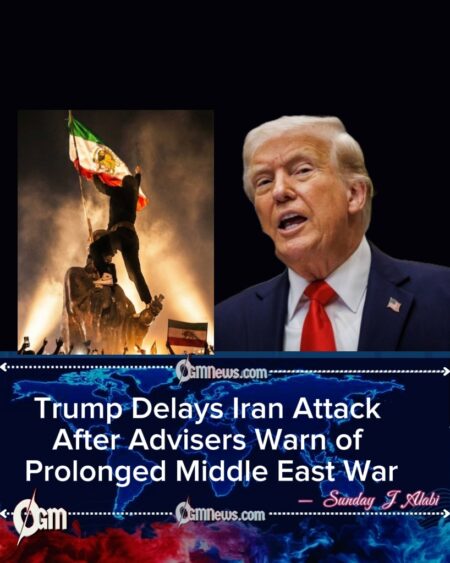
President Donald Trump, currently serving his second term as U.S. president, moved the United States to the edge of military confrontation with Iran this week before abruptly stepping back from launching strikes, following fresh intelligence and extensive consultations with advisers. The decision came after days of heated rhetoric, military preparations, and signals that action against Tehran was imminent.
Trump had publicly warned that he was “locked and loaded” to act against Iran, amid weeks of unrest in Tehran and other cities. His statements, coupled with a brief closure of Iranian airspace and the movement of U.S. military assets in the region, fueled expectations that American strikes were imminent.
However, the anticipated military action did not materialize. By Friday, the president struck a more restrained tone, emphasizing that developments on the ground in Iran—particularly a reported pause in executions—had influenced his thinking and prompted him to delay any attack.
Military Preparations and Escalating Signals
Throughout the week, U.S. officials maintained that “all options remain on the table” as Washington monitored Iran’s violent crackdown on protesters. White House press secretary Karoline Leavitt reiterated that the administration was prepared to act should conditions warrant it, reinforcing perceptions that a strike was under serious consideration.
According to multiple reports, senior military officials went to bed on Tuesday believing an attack could come as early as the next day. The temporary shutdown of Iranian airspace on Wednesday further heightened speculation that U.S. forces were preparing to strike Iranian military targets.
At the same time, Trump encouraged Iranian protesters to continue demonstrating, suggesting that external help might be forthcoming. Those remarks were widely interpreted as a signal of possible U.S. intervention in support of the unrest challenging Iran’s clerical leadership.
Advisers’ Warnings and Strategic Doubts
Behind the scenes, however, Trump was receiving stark assessments from a wide range of advisers. Officials reportedly warned that limited airstrikes were unlikely to topple Iran’s entrenched leadership and could instead entangle the United States in another long, uncertain conflict in the Middle East.
U.S. planners also expressed doubts about whether targeting Iranian military sites would meaningfully assist protesters or insurgent groups. Sources indicated there were concerns about the lack of sufficient weaponry and regional support to sustain a prolonged campaign if Iran retaliated.
Adding to the uncertainty was the absence of a clear post-regime plan. Advisers cautioned that there was no obvious or widely supported alternative leadership ready to govern Iran should Supreme Leader Ali Khamenei’s system collapse under external pressure.
Regional and International Calculations
The White House was simultaneously consulting closely with Israel and several Arab partners, including Qatar, the United Arab Emirates, and Saudi Arabia. These allies warned that U.S. bases in the region could face retaliation if Washington launched an attack on Iran.
Israeli Prime Minister Benjamin Netanyahu reportedly advised against immediate military action, telling Trump that it might already be too late for outside intervention to decisively influence events on the streets of Tehran. Other regional officials echoed concerns that Iran’s security forces had already suppressed much of the unrest.
Diplomatic pressure on Tehran nevertheless intensified. Britain, France, Germany, and Italy summoned Iranian ambassadors to protest the violent crackdown, underscoring growing international alarm over the scale of repression.
Protests, Repression, and a Heavy Human Cost
Iran’s unrest, sparked by severe economic hardship, has evolved into one of the most serious internal challenges to the Islamic Republic in decades. Demonstrations that began in late December escalated into direct confrontations with the ruling system, prompting a harsh response from security forces.
The U.S.-based Human Rights Activists News Agency has placed the death toll at more than 3,000, a figure that recalls the upheaval surrounding Iran’s 1979 revolution. The group, which relies on a network of activists inside the country, reports that the number continues to rise despite an outward return to calm in Tehran.
Although street life has largely resumed and protests have subsided in recent days, an internet blackout has persisted, and hard-line clerics have continued to call for severe punishments against detained demonstrators, including the death penalty.
Political Fallout and Questions of Trump Administration Credibility
Trump has insisted that no one forced his hand, saying he personally decided to pause military action after learning that hundreds of planned executions had been halted. He emphasized that the option of force remains available should Iran resume mass hangings or escalate violence against civilians.
Yet critics argue that the abrupt shift left Iranian protesters exposed. Suzanne Maloney, vice president for foreign policy at the Brookings Institution, warned that the episode has placed U.S. credibility at risk, potentially fostering a lasting sense of betrayal among Iranians who believed Washington would intervene.
Exiled Crown Prince Reza Pahlavi has continued to urge the United States to honor its pledges of support, even as Trump has expressed doubts about Pahlavi’s ability to command broad backing inside Iran. For now, the Trump administration’s decision has postponed, rather than resolved, the question of whether the United States will intervene more directly in Iran’s crisis.
[…] […]