















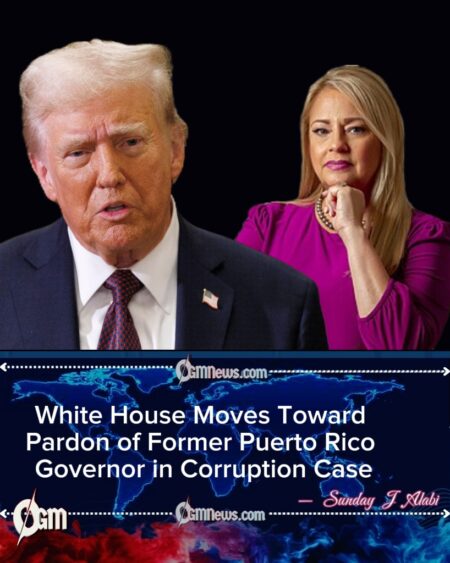
U.S. President Donald Trump, now serving a second term in office, is reportedly preparing to issue a presidential pardon to former Puerto Rico governor Wanda Vázquez Garced, a move that has reignited debate over the boundaries between justice, politics, and executive clemency. The reported decision follows years of legal proceedings stemming from federal corruption charges related to Vázquez’s 2019–2020 gubernatorial campaign and comes amid broader scrutiny of Trump’s expansive pardon strategy since returning to the White House in early 2025.
According to multiple reports, the planned pardon would not be limited to Vázquez alone but would also extend to her co-defendants, underscoring the administration’s position that the prosecution was politically motivated rather than rooted in demonstrable criminal conduct.
Background of the Case Against Wanda Vázquez Garced
Wanda Vázquez Garced served as governor of Puerto Rico from 2019 to 2021, assuming office during a period of significant political and economic turbulence on the island. In 2022, she was indicted by the U.S. Department of Justice on federal corruption charges tied to her campaign activities during her time in office.
Prosecutors initially accused Vázquez and her co-defendants of conspiracy, federal programs bribery, and honest-services wire fraud. The allegations centered on claims that campaign-related financial support was exchanged for favorable regulatory actions involving Puerto Rico’s banking oversight apparatus.
Allegations Involving Financial Influence and Regulatory Oversight
At the heart of the case were claims that Julio Martín Herrera Velutini, founder of Britannia Financial Group, and Mark Rossini, a former FBI agent turned consultant, sought to influence the appointment of Puerto Rico’s banking commissioner. Federal authorities alleged that the existing commissioner was scrutinizing Herrera’s bank for suspicious transactions.
According to court filings and media reports, Herrera and Rossini were accused of promising financial support to Vázquez’s campaign if she replaced the commissioner with an appointee deemed more favorable. More than $300,000 was allegedly paid to political consultants supporting Vázquez’s campaign during this period, raising concerns about improper influence over regulatory decisions.
Plea Deals and Shifts in the Prosecution
Despite initially denying all wrongdoing after her arrest in 2022, Vázquez ultimately accepted a plea deal in August, along with Herrera and Rossini. The defendants pleaded guilty to lesser corruption-related charges, a development that came as the case approached trial.
The plea agreements followed significant changes within the Justice Department, including the dismantling of its public integrity section, which had overseen the prosecution. Observers noted the speed with which the department moved to finalize the plea deals, fueling ongoing debate over the strength and direction of the case.
Political Context and Trump’s Endorsement Ties
Vázquez endorsed Donald Trump during his 2020 re-election campaign, a detail that has featured prominently in arguments advanced by her defense. According to White House officials, the investigation into Vázquez began just ten days after her endorsement of Trump, a timeline they argue supports claims of political motivation.
The defense further contends that the investigation extended beyond Vázquez’s campaign to include monitoring of Trump’s campaign activities. These assertions form a central pillar of the pardon request materials submitted to the White House, which explicitly deny any quid pro quo arrangement.
Financial Contributions and Links to Trump Allies
Adding to the controversy are substantial political donations made by Herrera’s family to Trump-aligned political organizations. Herrera’s daughter reportedly donated $2.5 million to Maga Inc, a pro-Trump Super PAC, following the initial charges, and later contributed an additional $1 million in mid-2024.
The legal team involved in negotiating the plea agreements included Chris Kise, a longtime ally and legal representative of President Trump. While no evidence has been presented linking these donations directly to the pardon decision, the financial and political intersections have drawn heightened public attention.
Trump’s Expansive Clemency Record in His Second Term
Since returning to office in early 2025, President Trump has pursued an assertive approach to executive clemency. His pardon record includes a broad array of individuals, ranging from business figures to political allies.
Among those previously pardoned are more than 1,500 individuals connected to the January 6, 2021 Capitol attack, a former Tennessee Republican convicted of federal public corruption, a former New York police sergeant convicted of assisting Chinese government intimidation efforts, and a cryptocurrency billionaire with ties to Trump family business interests. The reported pardon of Vázquez would further cement this pattern of high-profile clemency decisions.
Casinoabc999? Good Site. The interface is sleek, and there is a lot of stuff to...