




























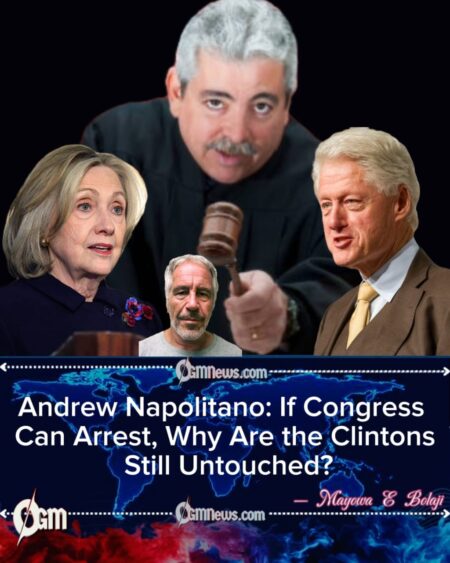
Andrew Napolitano, legal analyst and former New Jersey Superior Court Judge has placed renewed focus on congressional authority following the decision by Bill and Hillary Clinton to skip scheduled depositions connected to the Jeffrey Epstein investigation.
Speaking on Tuesday’s edition of Newsline, Andrew Napolitano offered a measured but firm interpretation of the law, stressing that Congress is not without enforcement power when witnesses decline to cooperate.
At the center of Napolitano’s analysis was a blunt assertion that has since echoed across political and legal commentary:
“Congressman Comer can have them arrested if he wants.” While not a call to action, the statement underscored Napolitano’s broader argument—that the issue is less about legal capability and more about political resolve.
Legal Perspective on Congressional Power
Andrew Napolitano approached the issue from a constitutional standpoint, emphasizing that congressional committees possess subpoena power that carries real legal consequences. According to Napolitano, this authority is grounded in long-standing precedent designed to support legislative oversight.
He clarified that when subpoenas or depositions are ignored, Congress may pursue contempt proceedings. Napolitano was careful to note that such actions are rare, not because they are unlawful, but because lawmakers often hesitate to escalate disputes involving influential political figures.
The Epstein Case Through Andrew Napolitano’s Lens
In his commentary, Napolitano situated the missed depositions within the broader and unresolved questions surrounding the Jeffrey Epstein case.
Epstein’s 2019 death in federal custody left significant gaps in public understanding, prompting lawmakers to seek testimony from individuals with potential knowledge of his activities and associations.
Napolitano argued that cooperation in such investigations is essential to public trust. While he did not single out the Clintons for unique criticism, he framed their absence as emblematic of a larger accountability problem when prominent individuals are involved.
Skipped Depositions and Andrew Napolitano’s Warning
Andrew Napolitano made clear that failing to appear for a congressional deposition does not automatically result in arrest. Instead, he described a layered legal process that requires committee action, formal votes, and often coordination with the Justice Department.
His warning was therefore procedural, not rhetorical.
Napolitano stressed that Congress’s reluctance to use its enforcement tools does not negate their existence, and persistent noncompliance risks weakening legislative oversight over time.
Political Realities Acknowledged by Napolitano
Beyond the law, Andrew Napolitano acknowledged the political calculations that shape congressional responses. Arresting or sanctioning high-profile political figures would carry immense political and institutional consequences, potentially overshadowing the investigation itself.
Napolitano suggested that lawmakers often weigh public perception and partisan backlash against the need to assert authority. In his view, this tension explains why Congress frequently stops short of exercising its full legal powers.
Public Debate Sparked by Andrew Napolitano’s Comments
Andrew Napolitano’s remarks have sparked renewed public debate about equality before the law. Supporters argue that his analysis reinforces constitutional principles and reminds Congress of its oversight responsibilities.
Critics, however, contend that such commentary risks inflaming partisan divisions. Napolitano has responded indirectly by reiterating that his role is to explain what the law allows—not to dictate how elected officials should act.
Andrew Napolitano and the Question of Accountability
Ultimately, Andrew Napolitano’s intervention has reframed the conversation around the Epstein inquiry, shifting focus from personalities to institutional authority. His analysis highlights a central question facing Congress: whether it is willing to use the powers it already has.
As the investigation continues, Napolitano’s comments serve as a reminder that accountability depends not only on laws written, but on the willingness of institutions to enforce them.

Casinoabc999? Good Site. The interface is sleek, and there is a lot of stuff to...