




























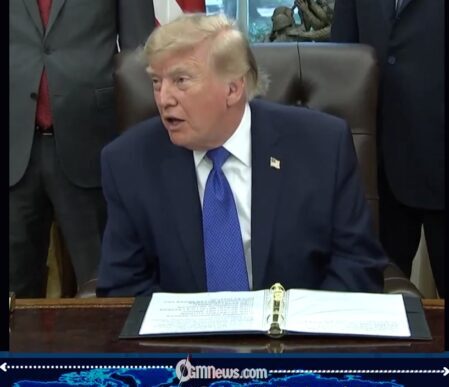
President Donald Trump announced a sweeping new stance toward major credit card companies, declaring that the long-running era of sky-high consumer interest rates is coming to an end. In remarks that immediately sent ripples through the financial sector, he said Americans have been “crushed for decades” by what he described as predatory lending practices hidden behind fine print and complex fee structures.
He explained that the focus of his administration is to bring fairness and transparency back into consumer finance, stressing that working families should not be trapped in endless debt cycles because of rates that can exceed 30 percent. According to officials familiar with the policy discussions, regulatory agencies are already preparing guidance that would sharply limit how high revolving credit rates can go.
Market analysts say the announcement alone has already forced several large card issuers to quietly reevaluate their pricing models. Some banks are reportedly running emergency projections to determine how a nationwide interest-rate ceiling would impact their profitability and future lending standards.
President Donald Trump and the New Consumer Push
President Donald Trump framed the proposal as part of a broader effort to “rebalance the financial system in favor of ordinary people,” arguing that previous administrations failed to confront what he sees as systematic abuse by major lenders. He said his goal is to ensure that access to credit does not automatically translate into long-term financial harm.
Banking executives, meanwhile, have begun holding internal meetings to discuss how to comply if a hard cap becomes federal policy. Several insiders told reporters that the industry is bracing for one of the most significant regulatory overhauls since the financial crisis era.
Consumer advocacy organizations welcomed the move, stating that millions of Americans remain trapped in revolving balances that barely shrink because interest charges consume most of their monthly payments.
How High Interest Rates Took Hold
The widespread use of ultra-high interest rates did not happen overnight. Over several decades, competition among lenders gradually shifted from customer service to profit maximization, with rates creeping upward as regulations loosened.
President Donald Trump criticized this trend, arguing that financial innovation became an excuse for companies to push charges far beyond what average families could realistically manage. He pointed out that in many cases, borrowers with modest incomes end up paying back two or three times what they originally borrowed.
Economists say that while credit cards expanded access to short-term financing, the long-term effects of excessive interest have contributed to rising household debt and increasing reliance on minimum payments.
Impact on Families and Small Businesses
Families across the country have reported struggling to break free from balances that seem to grow even when they pay on time. Small business owners, who often rely on credit cards for startup capital, say that high interest has made expansion risky and sometimes impossible.
President Donald Trump highlighted stories from entrepreneurs who claimed their profits were eaten away by finance charges, forcing them to delay hiring and reduce investment. He described the situation as a “silent tax” on productivity.
Financial counselors note that interest-heavy debt is one of the most common reasons households fail to build emergency savings or qualify for long-term loans like mortgages.
What Credit Card Companies Are Saying
Major lenders have issued carefully worded statements acknowledging the administration’s position while warning that drastic caps could reduce access to credit for higher-risk borrowers. Some executives argue that rates reflect lending risk and operating costs.
President Donald Trump rejected that defense, stating that risk has become a “blanket excuse” rather than a fair calculation. He insisted that a healthier system would still allow lenders to profit without trapping customers in perpetual repayment cycles.
Industry lobbyists are now expected to push for phased-in reforms rather than immediate caps, hoping to soften the financial impact on large issuers.
The Road Ahead for Consumer Credit
Federal agencies are expected to draft formal proposals in the coming months, which could include mandatory interest ceilings, clearer disclosure rules, and stricter penalty limits for late payments.
President Donald Trump said his administration would monitor the rollout closely to ensure the changes result in real relief, not cosmetic adjustments. He added that Americans deserve a credit system that helps them build financial stability rather than undermining it.
Economists predict that if the measures pass, they could reshape lending models nationwide, forcing companies to rely more on responsible underwriting rather than high interest margins.
President Donald Trump closed his remarks by promising that this initiative is only the beginning of a larger financial reform agenda. He emphasized that restoring fairness in consumer lending is central to strengthening the middle class and protecting future generations from debt-driven instability.

[…] […]