




























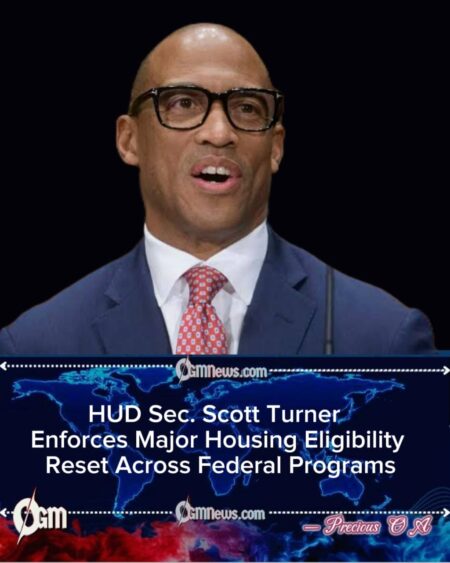
HUD Sec. Scott Turner formally announced a major shift in federal housing policy this week, reversing prior interpretations that had expanded access to taxpayer-backed mortgages and subsidized housing programs to applicants without lawful immigration status. The change immediately affects federally insured mortgage programs and public housing authorities nationwide.
The Department of Housing and Urban Development confirmed that the revised standards reinforce statutory eligibility requirements and tighten verification procedures for applicants seeking housing assistance supported by federal funds.
Officials said the move represents one of the most significant housing eligibility resets in decades and will require coordinated implementation across lenders, state housing agencies, and local authorities.
Legal Framework Behind the Change
Federal housing statutes have long defined eligibility criteria for taxpayer-funded assistance, but interpretations had varied widely between jurisdictions. Internal compliance reviews found inconsistencies that prompted a full reassessment of enforcement standards.
HUD officials stated that the revised policy restores uniform legal compliance by requiring verification of lawful status prior to approval for insured mortgage programs and subsidized housing placements.
Legal analysts note that the changes align housing programs more closely with federal law and are likely to strengthen long-term fiscal accountability.
Implementation Measures
HUD Sec. Scott Turner directed compliance divisions to establish a new national monitoring framework that includes quarterly reporting, documentation audits, and standardized verification procedures.
Local housing authorities have begun updating application screening protocols to reflect the new guidance and are retraining staff to ensure consistent enforcement.
HUD confirmed that technical guidance will be distributed to housing agencies over the next several weeks to support a smooth transition.
Impact on Housing Markets
Mortgage lenders are reviewing applicant pipelines to ensure underwriting practices meet the revised eligibility standards. Some lenders report short-term processing delays as verification systems are updated.
Housing economists suggest the changes could modestly ease pressure on subsidized housing supply in high-demand metropolitan areas.
Developers working on federally assisted projects are also revising compliance language within leasing and financing agreements.
HUD Sec. Scott Turner’s Broader Agenda
HUD Sec. Scott Turner indicated that the housing eligibility reset is part of a broader effort to modernize federal housing governance and strengthen program integrity.
Future reforms under review include digital verification platforms, enhanced fraud detection tools, and uniform compliance reporting standards.
Department officials say the goal is to ensure housing programs remain legally compliant, fiscally sustainable, and transparent.
Public and Political Response
HUD Sec. Scott Turner has continued to defend the policy publicly, emphasizing that taxpayer-funded programs must operate within clearly defined legal boundaries.
State and local governments are now issuing implementation statements and preparing outreach materials to inform applicants of the updated requirements.
Policy analysts say the reform may shape future housing legislation debates and influence broader discussions about federal program accountability.


[…] […]