

























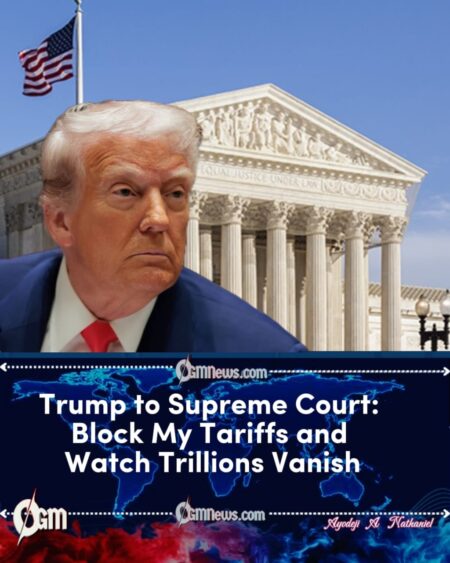
Donald Trump, currently serving his second term as U.S. president, has issued a stark warning about the economic consequences if the Supreme Court overturns his administration’s tariff regime. Speaking forcefully on the issue, Trump argued that an adverse ruling could leave the United States facing repayment obligations running into hundreds of billions—or even trillions—of dollars, with long-term implications for national finances and economic stability.
The comments place renewed focus on the high-stakes legal battle over tariffs imposed on national security grounds, a dispute that now sits at the intersection of trade policy, constitutional authority, and fiscal risk.
President Donald Trump Frames Tariffs as a National Security Pillar
President Donald Trump has consistently defended his tariff policy as a cornerstone of national security and economic sovereignty. According to the president, the duties have driven massive domestic and foreign investment into the United States, strengthening supply chains and protecting key industries.
He argues that undoing these measures retroactively would not simply reverse policy but create an unprecedented financial obligation, forcing the government to unravel years of trade decisions and investment flows.
The Supreme Court Case and Its Financial Stakes
At the center of the controversy is a pending decision by the Supreme Court of the United States, which is reviewing challenges to the administration’s authority to impose tariffs under national security laws. Critics argue the tariffs exceed executive power, while supporters maintain they fall squarely within statutory limits.
President Donald Trump has warned that if the Court rules against the government, the United States could be required to refund tariffs already collected—an outcome he says would be financially devastating and administratively chaotic.
President Donald Trump on the Cost of Reversal
In his remarks, President Donald Trump stressed that the potential repayment figures are not easily quantifiable. He suggested that calculating who should be paid, how much, and over what timeline could take years, given the scale and complexity of global trade transactions affected by the tariffs.
The president dismissed claims that any refund process could be handled quickly, calling such assertions unrealistic and disconnected from the scope of the issue.
Economic Impact and Investor Confidence
Economists note that a ruling against the tariffs could introduce uncertainty into global markets, particularly if it casts doubt on the durability of U.S. trade policy. Supporters of the administration argue that upholding the tariffs would reassure investors who committed capital based on existing rules.
President Donald Trump has linked the tariff framework directly to broader economic confidence, insisting that when the United States projects strength, it stabilizes markets worldwide.
Political and Legal Reactions
The president’s warning has drawn mixed reactions. Allies view his comments as a necessary alert to the potential consequences of judicial intervention in trade policy, while critics accuse him of overstating the risks to pressure the Court.
Legal scholars emphasize that the Supreme Court’s decision will likely hinge on statutory interpretation rather than economic outcomes, though the scale of potential financial exposure underscores the importance of the case.
What Comes Next for Trade Policy
As the Supreme Court deliberates, President Donald Trump has made clear that he views the case as pivotal to his broader economic agenda. A ruling in favor of the administration would reinforce executive authority over trade in the name of national security.
A ruling against it, however, could reshape tariff policy for years to come, forcing Congress and future administrations to rethink how trade enforcement is structured under U.S. law.
[…] […]