















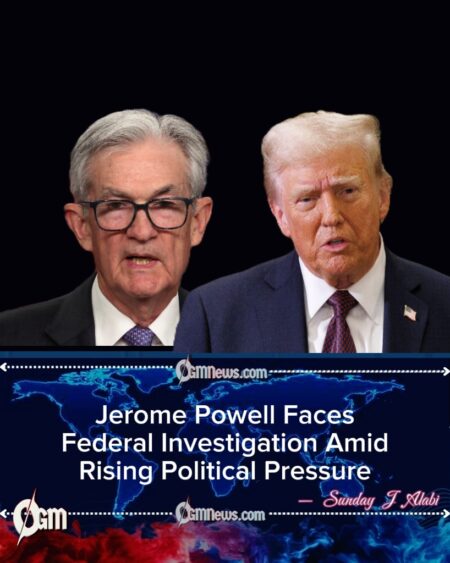
Federal prosecutors in Washington have opened a criminal investigation into Jerome Powell, the chair of the U.S. Federal Reserve, triggering a rare and consequential confrontation between the nation’s central bank and the justice system. The inquiry focuses on whether Powell misled Congress about the scope, cost, and features of a multibillion-dollar renovation of the Federal Reserve’s historic headquarters in Washington, D.C.
In a defiant response delivered Sunday night, Powell rejected the legitimacy of the investigation and framed it as a direct consequence of political pressure over monetary policy. He warned that the probe threatens the Federal Reserve’s long-standing independence, arguing that interest-rate decisions must remain guided by economic evidence rather than intimidation from elected officials.
The investigation has sharply escalated tensions between Powell and President Donald Trump, the current U.S. president serving a second term, who has repeatedly criticized the Fed chair for resisting aggressive interest-rate cuts. Together, the legal scrutiny and political backdrop have plunged the central bank into an unusually volatile moment.
Scope of the Federal Investigation and Prosecutorial Oversight
According to officials briefed on the matter, the U.S. Attorney’s Office for the District of Columbia is examining Powell’s congressional testimony, internal Federal Reserve records, and spending decisions related to a sweeping renovation of the Fed’s Washington buildings near the National Mall. The inquiry was approved in November by U.S. Attorney Jeanine Pirro, a longtime Trump ally appointed to lead the office last year.
Investigators are assessing whether Powell provided inaccurate or misleading information to lawmakers about the renovation’s design elements and escalating costs. Officials familiar with the probe say both Powell and the Federal Reserve have received grand jury subpoenas, and prosecutors have requested extensive documentation tied to the project.
The Justice Department has not publicly detailed the evidence under review. A spokesperson for Attorney General Pam Bondi declined to comment specifically on the Powell investigation, stating only that U.S. attorneys have been instructed to prioritize cases involving potential misuse of taxpayer funds.
Powell’s Defiant Response and Claims of Political Retaliation
In a rare video message, Powell described the investigation as “unprecedented” and asserted that it was not genuinely about congressional oversight or construction costs. He argued that the scrutiny represents retaliation for the Federal Reserve’s refusal to tailor interest-rate policy to the president’s preferences.
“The threat of criminal charges is a consequence of the Federal Reserve setting interest rates based on our best assessment of what will serve the public,” Powell said, adding that monetary policy must be driven by economic conditions rather than political pressure. He maintained that the Fed made extensive efforts to keep Congress informed through testimony and public disclosures.
Powell further warned that the case could set a dangerous precedent, raising fundamental questions about whether the central bank can continue to operate independently. His remarks underscored broader concerns among economists and policymakers about the erosion of institutional boundaries.
President Trump’s Response and Ongoing Criticism of the Fed Chair
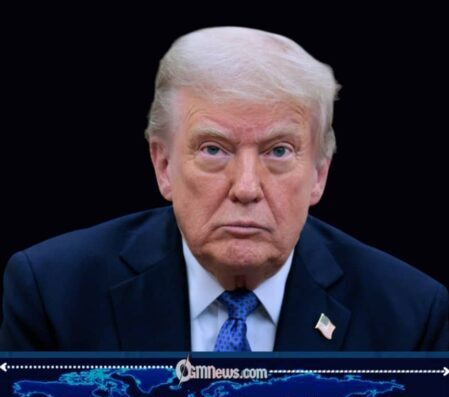
President Trump denied any involvement in the initiation of the criminal probe but renewed his criticism of Powell’s leadership. Speaking Sunday night, the president said he was unaware of the investigation’s details while accusing the Fed chair of mismanaging both monetary policy and the renovation project.
“I don’t know anything about it, but he’s certainly not very good at the Fed, and he’s not very good at building buildings,” Trump said. The president has repeatedly accused Powell of “incompetence” and has publicly floated the idea of removing him over disagreements on interest rates.
Trump has also suggested legal action related to the renovation, which he has criticized as excessively expensive. In previous remarks, the president argued that sharply lower interest rates could significantly boost the U.S. economy, estimating potential gains in the hundreds of billions of dollars.
The Renovation Project Under Scrutiny
At the center of the controversy is a renovation project launched in 2022 to modernize the Marriner S. Eccles Building and a second Federal Reserve structure on Constitution Avenue. The buildings, dating back to the 1930s, had not undergone comprehensive renovations in nearly a century.
Federal Reserve officials say the overhaul is necessary to remove asbestos and lead, upgrade outdated infrastructure, and ensure compliance with accessibility requirements for people with disabilities. The project is scheduled for completion in 2027 and is now estimated to cost about $2.5 billion, roughly $700 million over its original budget.
Critics have seized on early planning documents that referenced features such as private dining areas, upgraded elevators, marble installations, and a rooftop terrace. During congressional testimony last June, Powell forcefully denied that such features were part of the current plan, saying several elements were scrapped as designs evolved.
Congressional Testimony, Cost Overruns, and the Fed’s Defense
When questioned by lawmakers, Powell stated that there was “no V.I.P. dining room” and “no new marble,” explaining that existing marble was being removed and restored where possible. He emphasized that the elevators being upgraded were longstanding fixtures, not luxury additions.
Following his testimony, the Federal Reserve published a detailed online FAQ, complete with photographs, annotations, and a virtual tour of the renovation, aimed at reinforcing Powell’s claims. The central bank attributed cost overruns to rising labor and materials prices, as well as unexpected issues such as additional asbestos and soil contamination.
Whether those explanations satisfy prosecutors remains uncertain. Launching an investigation does not guarantee criminal charges, and prosecutors must still persuade a federal grand jury that sufficient evidence exists to warrant an indictment and withstand judicial scrutiny.
Broader Implications for Fed Independence and Leadership Succession
The investigation arrives at a pivotal moment for the Federal Reserve. Powell’s term as Fed chair expires in May, though his term as a member of the Board of Governors runs through January 2028. He has not said whether he intends to remain at the central bank beyond this year.
President Trump told The New York Times last week that he has already decided whom he wants to nominate as Powell’s replacement and is expected to announce his choice soon. Kevin A. Hassett, the president’s top economic adviser, has emerged as a leading contender.
Recent history underscores the uncertainty surrounding high-profile federal investigations. Indictments brought last year against former FBI Director James Comey and New York Attorney General Letitia James were dismissed, while another probe involving Senator Adam Schiff has yet to yield charges. Against that backdrop, the Powell investigation stands as both a legal test and a defining moment for the independence of the U.S. central bank.
[…] […]