





















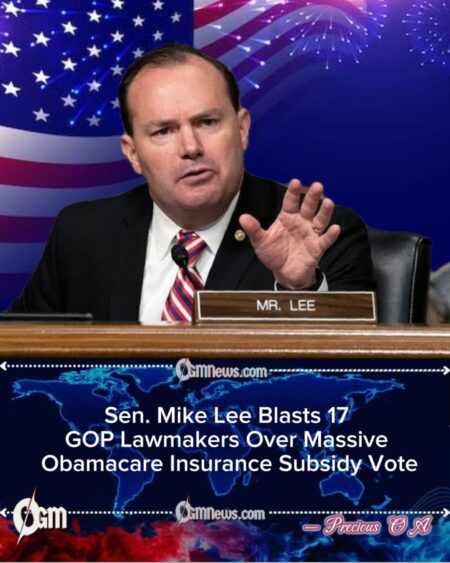
Sen. Mike Leehttps://ogmnews.com/venezuela-standoff-shifts-trump-calls-off-second/ publicly scorched 17 House Republicans this week after they voted in favor of legislation that would allocate tens of billions of dollars toward insurance subsidies tied to the Affordable Care Act, commonly known as Obamacare. Lee described the vote as a dramatic departure from conservative principles and warned it could saddle taxpayers with long-term fiscal commitments.
The criticism was delivered during an interview with reporters at the Capitol, where Lee framed his remarks in the context of fiscal restraint, limited government, and skepticism toward expanded federal spending. He emphasized that the vote reflects what he sees as a deeper philosophical divide within the Republican Party.
Lee’s comments quickly became a flashpoint in the broader debate over health care funding, illustrating ongoing tensions between pragmatic coalition-building in Congress and ideological commitments held by some conservative lawmakers.
GOP Division on Health Funding
The vote in question came as part of a broader legislative push to address rising health insurance costs and stabilize the individual market, which has faced volatility in recent years. Supporters of the spending argued that increasing federal subsidies would lower premiums and expand access for millions of Americans.
Opponents, including Lee, countered that bolstering Obamacare subsidies undermines efforts to reform the health care system and moves the federal budget further toward unsustainable spending patterns. They also warned of potential unintended market distortions.
Within the House Republican Conference, the division highlighted a growing schism between establishment figures willing to embrace targeted spending increases and a conservative faction that insists on strict adherence to fiscal constraints.
Sen. Mike Lee’s Fiscal Argument
Sen. Mike Lee reiterated his concern that the spending package represents an expansion of federal involvement in health care costs, rather than meaningful reform. He argued that the approach does little to address the underlying structural issues associated with rising premiums and uneven market competition.
Lee emphasized that federal subsidies, especially large ones, effectively transfer the cost burden to taxpayers while insulating consumers from price signals that drive market behavior. He described this as a short-term fix with potentially long-term consequences.
His comments reflect a broader philosophy favoring limited government intervention and market-driven solutions, a stance that has both supporters and critics in conservative policymaking circles.
House Republicans Who Voted Yes
The list of 17 Republican House members who supported the funding proposal includes lawmakers from both moderate and traditionally conservative districts. Their willingness to diverge from the leadership’s rhetoric on limited spending drew immediate scrutiny from colleagues like Lee.
Representatives who voted in favor have defended their position by emphasizing constituent needs, particularly in districts where health care affordability remains a pressing concern. They argue that stabilizing the insurance markets requires pragmatic solutions, even if they involve increased federal outlays.
Some of these lawmakers have publicly expressed frustration with the internal Republican fight, noting that the disagreement could have repercussions for party unity and messaging as national elections approach.
Policy Implications and Public Reaction
The debate over health care funding has sparked reactions not only within Congress but also among voters and interest groups. Advocacy organizations on both sides have issued statements, with some praising the vote as necessary protection for vulnerable populations, while others echoed Lee’s warnings about fiscal imprudence.
Public polling on health care policy suggests that many Americans support government efforts to make insurance more affordable, though views vary widely along partisan lines. Republicans remain divided between prioritizing cost containment versus expanding access through government mechanisms.
Analysts say that the vote could influence future negotiations on related matters, such as Medicaid expansion, prescription drug pricing, and regulatory reform, potentially shaping the legislative agenda well beyond the immediate controversy.
Congressional Fallout and Next Steps
Sen. Mike Lee and other critics have signaled that the vote could have legislative consequences, including implications for committee assignments, campaign support, and intra-party leadership dynamics. Some conservatives have called for formal challenges to the funding provision, though the legislative path for such efforts remains uncertain.
House Republican leaders have tried to defuse the conflict by emphasizing shared goals, such as reducing overall health care costs and preserving market stability. They argue that compromise is necessary in a divided government where bipartisan cooperation is sometimes required to move key legislation.
Despite the tensions, congressional aides indicate that lawmakers on both sides are already preparing for follow-on debates, including potential budget negotiations that will revisit health care expenditures and broader federal spending priorities.
Broader Fiscal and Political Context
The clash over Obamacare-related spending underscores a larger philosophical divide in U.S. politics between advocates of increased federal support for social programs and proponents of fiscal restraint and smaller government. Health care remains one of the most contentious areas in this broader discussion.
Republicans who supported the funding package assert that failing to act could worsen market instability and harm constituents, while critics like Lee maintain that long-term fiscal discipline should take precedence. This dynamic reflects larger tensions that are shaping the party’s identity as election cycles approach.
Observers say that how this dispute is resolved could influence future Republican strategies on health care, taxes, and spending, with potential implications for electoral campaigns and policymaking alike.
[…] […]