


























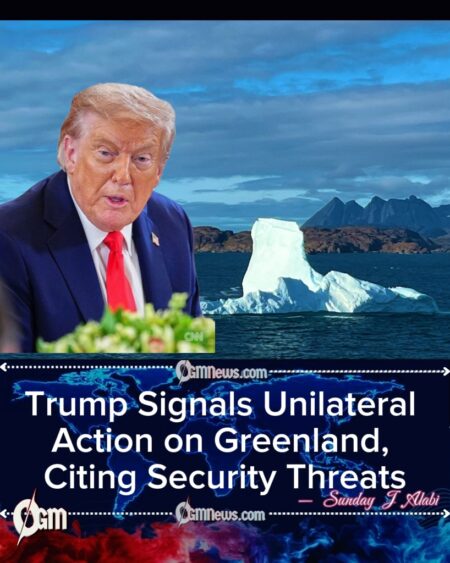
President Donald Trump, the current U.S. president serving a second term, has declared that the United States will take decisive action regarding Greenland “whether they like it or not,” intensifying diplomatic tensions with Denmark, Greenland’s leadership, and key European allies. Trump’s remarks, delivered to reporters in Washington, signal a renewed and more forceful push to secure control over the strategically vital Arctic territory, citing national security concerns linked to Russia and China.
The statements have prompted urgent diplomatic engagements between U.S., Danish, and Greenlandic officials, while also triggering debate within the U.S. Congress and across NATO. Although the administration insists it prefers a negotiated outcome, Trump’s language has raised questions about the scope and methods of Washington’s intentions.
Strategic Rationale Behind Trump’s Greenland Push
President Trump framed Greenland as a critical security asset, arguing that failure by the United States to act would open the door for rival powers. According to Trump, Russia or China could expand their influence in the Arctic if Washington does not assert stronger control over the territory, a prospect he described as unacceptable for U.S. national security.
Greenland’s geographic position, straddling the Arctic and North Atlantic approaches to North America, has long made it strategically significant. As climate change accelerates Arctic ice melt, new shipping routes and access to mineral resources have increased global competition in the region, amplifying U.S. concerns about rival military or economic footholds.
Ownership Versus Treaties: Trump’s Core Argument
In an interview with The New York Times, Trump argued that outright ownership of Greenland would provide advantages that existing agreements cannot. He contrasted ownership with treaties or leases, saying that legal possession would grant the United States broader authority and flexibility than documents alone could provide.
Currently, the United States operates under a 1951 treaty with Denmark that allows it to establish military bases in Greenland with Danish and Greenlandic consent. Trump acknowledged the treaty but maintained that it falls short of what he views as necessary to secure long-term U.S. strategic interests in the Arctic.
Diplomacy, Money, and the Question of Force
When asked about potential financial offers to purchase Greenland, Trump said he is not “talking money” at this stage, though he left open the possibility of discussing it in the future. Secretary of State Marco Rubio reportedly told lawmakers that the president’s preference is to acquire Greenland through negotiation rather than coercion.
However, Trump’s warning that the United States could pursue the matter “the hard way” if diplomacy fails has unsettled allies. While he did not elaborate on what that phrase entails, the ambiguity has fueled speculation about economic pressure or military options, despite official assurances that force is not the administration’s preferred path.
Danish and Greenlandic Response to U.S. Pressure
Danish officials and Greenland’s representatives have moved swiftly to counter Trump’s rhetoric. Denmark’s ambassador to the United States, Jesper Møller Sørensen, and Greenland’s chief representative in Washington, Jacob Isbosethsen, met with White House National Security Council officials to convey their opposition to any unilateral U.S. action.
The envoys have also engaged members of Congress in an effort to build resistance to the administration’s approach. Denmark, a NATO member, has formally requested talks with Washington, emphasizing that Greenland’s future should be determined by its people, not imposed by external powers.
NATO, Europe, and Rising Transatlantic Tensions
Trump’s remarks on Greenland have coincided with renewed criticism of NATO, further straining relations with Europe. The president accused alliance members of failing to meet defense spending commitments and relying excessively on U.S. military support, asserting that only American power effectively deters Russia and China.
European leaders have responded with alarm. Danish Prime Minister Mette Frederiksen warned that a U.S. takeover of Greenland would undermine the NATO alliance itself. Leaders of France, Germany, Italy, Poland, Spain, and the United Kingdom jointly reaffirmed that Greenland “belongs to its people,” signaling rare unity against Washington’s stance.
Domestic Pushback and Congressional Concerns
Within the United States, Trump’s approach has drawn criticism from both parties. Republican Senator Lisa Murkowski of Alaska described the rhetoric surrounding Greenland as “profoundly troubling,” reflecting unease among lawmakers about the implications for international law and alliance stability.
Vice President JD Vance, however, defended the administration’s position, urging European leaders to take U.S. security concerns seriously. He argued that if allies fail to safeguard the territory adequately, the United States may feel compelled to act to protect its interests.
Greenland’s People and the Broader Stakes
Greenland, where roughly 80 percent of the land lies above the Arctic Circle, is home to about 56,000 people, most of them Inuit. Beyond its strategic location, the island is rich in minerals critical to modern technologies, adding an economic dimension to the geopolitical debate.
As diplomatic efforts continue, Greenland’s status has become a focal point in a broader contest over Arctic security, alliance cohesion, and the balance of power. Whether Trump’s ambition can be reconciled with international norms and allied relationships remains an open and consequential question.


[…] […]