


























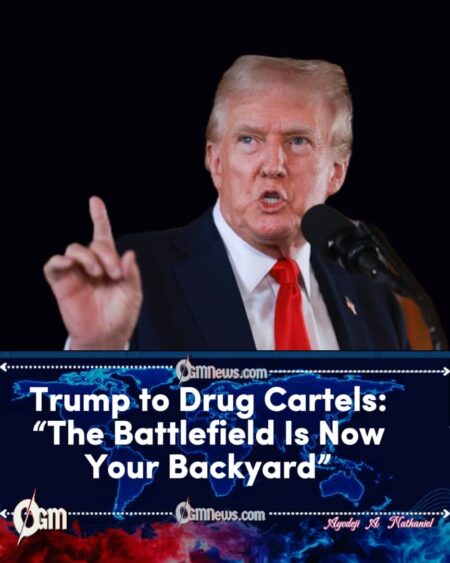
President Donald Trump, the current U.S. president serving a second term, has announced that the United States military will soon begin targeting drug cartels on land, signaling a potential expansion of America’s counter-narcotics strategy beyond air and maritime operations. Speaking publicly, President Trump said the United States would start “hitting land, with regard to the cartels,” asserting that criminal organizations have gained extensive control in parts of Mexico and other regions where they operate.
The announcement has immediately drawn attention from policymakers, security analysts, and regional governments, as it raises significant questions about sovereignty, legal authority, and the scope of U.S. military involvement in combating transnational organized crime.
President Donald Trump Outlines a Shift in Strategy
President Donald Trump framed the announcement as a necessary escalation in the fight against powerful drug trafficking organizations. He argued that cartels have grown emboldened, operating with near impunity in some areas and posing a direct threat to U.S. national security through narcotics trafficking, violence, and corruption.
According to the President Trump, the United States can no longer rely solely on indirect measures. His remarks suggest a belief that previous approaches—focused on law enforcement cooperation, sanctions, and border security—have been insufficient to dismantle cartel leadership and infrastructure.
What ‘Striking on Land’ Could Mean
While President Trump did not provide operational details, defense analysts note that “striking on land” could encompass a range of actions, from targeted raids and special operations to coordinated strikes against cartel facilities. Any such actions would likely involve elite military units rather than large-scale troop deployments.
Officials familiar with counter-narcotics operations caution that land-based actions raise complex logistical and diplomatic challenges. These include coordination with host nations, intelligence reliability, and the risk of civilian harm in areas where cartels operate among local populations.
Legal Authority and Congressional Oversight
President Trump’s statement has renewed debate over the legal framework governing overseas military action. Under U.S. law, sustained or expanded military operations typically require clear authorization, whether through existing statutes or congressional approval.
Lawmakers from both parties are expected to seek clarification on the administration’s legal rationale. Questions include whether the actions would fall under existing counterterrorism or counter-narcotics authorities, and how Congress would be informed or involved as plans move forward.
Implications for Mexico, Colombia, and Regional Partners
Countries such as Mexico and Colombia have long cooperated with the United States on counter-narcotics efforts, primarily through intelligence sharing, training, and joint law enforcement initiatives. A unilateral U.S. military role on land could strain these partnerships if not coordinated closely with host governments.
Regional leaders have historically emphasized respect for sovereignty, even while acknowledging the threat posed by cartels. Analysts warn that any perception of unilateral action could complicate diplomatic relations and domestic politics within affected countries.
Supporters Cite Security Gains, Critics Warn of Escalation
Supporters of the President Donald Trump’s approach argue that decisive military action could disrupt cartel operations, deter violence, and reduce the flow of drugs into the United States. They contend that cartels function like insurgent networks and should be confronted with comparable force.
Critics, however, caution that militarization risks escalation, retaliation, and unintended consequences. Past experiences in the region show that dismantling cartel leadership can fragment groups, sometimes leading to increased violence rather than stability.
What Comes Next
The administration has not announced a timeline or specific locations for the proposed operations. Defense officials are expected to brief Congress and allies as planning continues, while legal and diplomatic consultations are likely to intensify.
As the debate unfolds, the central issue remains whether expanded military action can achieve lasting results against transnational cartels without triggering broader regional instability or legal challenges at home.
[…] […]