



























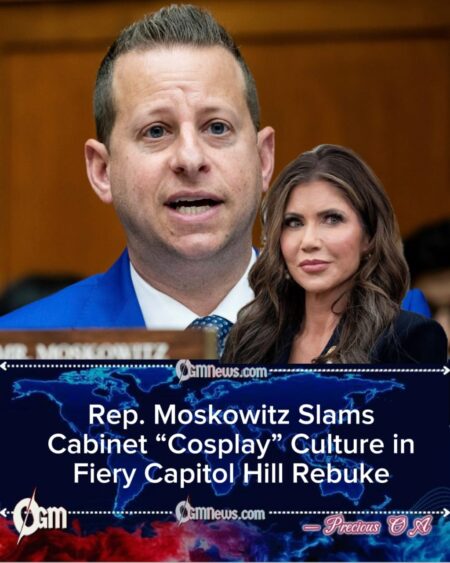
Rep. Moskowitz ignited a fresh political storm on Capitol Hill this week after delivering blistering public criticism of Homeland Security Secretary Kristi Noem, accusing her of prioritizing performative “cosplay-style” public appearances over the serious responsibilities of her office. His comments quickly spread across political media, triggering a broader debate about professionalism, optics, and leadership standards inside the executive branch.
He framed his remarks as a warning rather than a personal attack, saying that public trust in national institutions is being eroded by what he described as theatrical distractions that replace substantive governance. Allies say the congressman’s frustration reflects mounting anxiety inside Congress about optics replacing policy outcomes.
Political observers note that his language was unusually sharp for a sitting member of Congress, signaling that tensions between certain lawmakers and the administration have entered a more confrontational phase.
Rep. Moskowitz and the Culture Clash in Washington
Rep. Moskowitz doubled down on his criticism during a follow-up interview, emphasizing that cabinet officials should be evaluated by measurable policy performance, not their social-media appeal or public image campaigns. He said that leadership must project seriousness during a time of heightened national and global security concerns.
Some Democratic colleagues echoed his concerns, noting that voters increasingly express fatigue with what they perceive as “performative governance.” Others, however, cautioned that public criticism of cabinet members could inflame partisan divisions further.
A small number of Republican lawmakers defended Noem, arguing that modern communication strategies are necessary to reach younger demographics and that visual branding does not automatically negate policy competence.
Public Reactions and Media Amplification
Rep. Moskowitz became the centerpiece of cable-news panels and trending social-media discussions, with supporters praising him for “saying what others are afraid to say.” Clips of his remarks circulated widely, fueling debate about whether his tone crossed a line or reflected overdue accountability.
Commentators across the political spectrum noted that such strongly worded condemnations can influence public perceptions far beyond Capitol Hill, shaping narratives that linger long after legislative sessions conclude.
Media analysts pointed out that once political disputes become viral, they often harden public opinion, making compromise more difficult and amplifying polarization.
Questions of Leadership and Accountability
Rep. Moskowitz later clarified that his remarks were directed at institutional standards rather than personal character, insisting that his goal was to push for higher levels of seriousness within the federal government. He argued that symbolic theatrics risk overshadowing policy work on immigration, disaster response, and national preparedness.
Supporters framed his stance as part of a larger call for accountability, saying that cabinet officials should be held to rigorous performance metrics just like agency employees.
Critics countered that political theatrics exist on both sides of the aisle and warned that focusing on optics could distract lawmakers from legislative problem-solving.
Political Fallout and Strategic Calculations
Rep. Moskowitz also hinted that continued public dissatisfaction could translate into formal congressional scrutiny if voters demand deeper investigations. His remarks have already prompted internal party discussions about messaging discipline and the risks of escalating rhetoric.
Strategists say such disputes are often as much about shaping narratives ahead of future elections as they are about immediate policy disagreements. Public criticism of cabinet officials can energize a political base while also mobilizing opposition.
Meanwhile, political advocacy groups have begun using the controversy to rally supporters, framing the dispute as a referendum on leadership standards in Washington.
The Broader Debate on Governance
Rep. Moskowitz concluded his public comments by urging a renewed focus on results, transparency, and institutional credibility. He stressed that public officials must demonstrate seriousness to rebuild trust in government at a time when skepticism toward institutions is growing.
Policy analysts say the controversy underscores a wider cultural shift in American politics, where presentation and performance increasingly compete with policy depth for public attention.
As the debate continues, lawmakers from both parties face pressure to clarify where they stand on the balance between modern political branding and traditional standards of public service — a tension that is likely to remain a defining issue in Washington well beyond this single dispute.


[…] […]