



























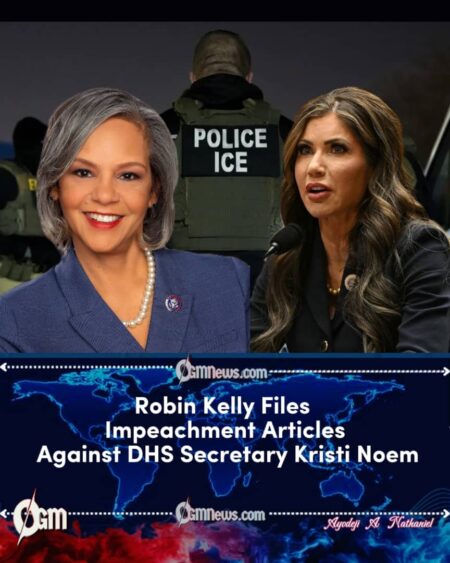
Representative Robin Kelly, a Democrat from Illinois, has filed articles of impeachment against Homeland Security Secretary Kristi Noem in the aftermath of an incident in Minneapolis involving Immigration and Customs Enforcement (ICE). Kelly’s action, announced publicly, accuses the DHS secretary of constitutional violations and misconduct related to federal immigration enforcement. The move has intensified partisan tensions and triggered sharp debate over the appropriate response to the Minneapolis incident, the role of ICE, and the threshold for impeachment of executive officials.
Robin Kelly Moves to Impeach DHS Secretary Kristi Noem
Robin Kelly said her decision to file impeachment articles was driven by what she described as a pattern of abuses under Secretary Noem’s leadership. In a statement accompanying the filing, Kelly accused Noem of allowing ICE to operate in ways she claims violate constitutional protections and harm immigrant families.
The impeachment filing is directed at Noem personally, not at DHS broadly, and represents one of the most aggressive congressional actions taken against the department’s leadership since the Minneapolis incident. Kelly framed the measure as a necessary step to restore accountability at DHS.
Minneapolis Incident Raises Political Stakes
Kelly’s action followed an incident in Minneapolis that authorities are still assessing, with limited confirmed details publicly available at this stage. While some lawmakers and activists have characterized the episode as an attack linked to immigration enforcement tensions, officials have cautioned that investigations are ongoing.
The uncertainty surrounding the incident has not slowed political reaction. Instead, it has become a flashpoint in the broader national debate over ICE operations, public safety, and the use of federal power in major U.S. cities.
Allegations Against Kristi Noem and ICE Leadership
In her statement, Kelly accused Secretary Noem of turning ICE into what she called a “rogue force,” alleging constitutional violations, family separations, and loss of life tied to enforcement actions. These claims echo long-standing criticisms from immigration advocates and some Democratic lawmakers.
The Department of Homeland Security has previously defended ICE’s actions as lawful and necessary to enforce federal immigration statutes. Noem and her allies argue that enforcement decisions are grounded in existing law and aimed at maintaining national security and public order.
Legal and Political Hurdles to Impeachment
Impeachment of a Cabinet secretary requires approval by the House of Representatives and, if adopted, a trial in the Senate. Historically, such efforts face steep odds, particularly in a closely divided or opposition-controlled chamber.
Legal experts note that impeachment is a political process rather than a criminal one, and its success depends as much on congressional support as on the underlying allegations. Even critics of DHS leadership acknowledge that removing a sitting secretary through impeachment is rare.
Partisan Reactions and Escalating Rhetoric
Republicans and some conservative commentators have dismissed Kelly’s filing as politically motivated and unlikely to advance. They argue that impeachment rhetoric is being used to score political points rather than to address facts emerging from the Minneapolis investigation.
Democrats backing Kelly counter that strong action is warranted to confront what they see as systemic misconduct within DHS. The exchange reflects deepening polarization over immigration policy and executive accountability.
Broader Implications for Immigration and Governance
The impeachment filing underscores how immigration enforcement has become a central fault line in U.S. politics. Beyond the fate of the resolution itself, the episode is likely to influence upcoming oversight hearings, DHS policy debates, and campaign messaging.
As investigations into the Minneapolis incident continue, Congress faces pressure to balance fact-finding with political restraint. Whether Kelly’s move gains traction or stalls, it has already amplified scrutiny of DHS leadership and federal immigration enforcement.



[…] […]