


























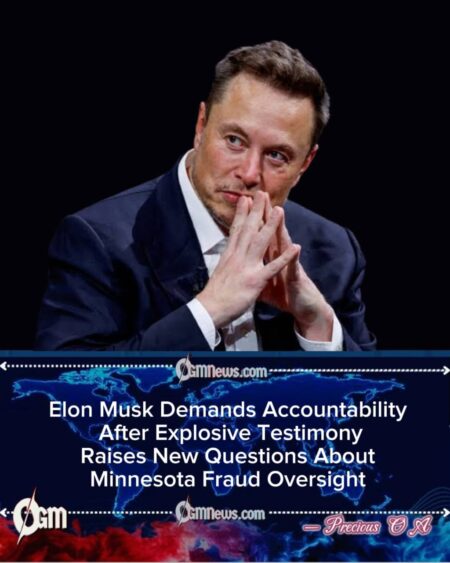
Elon Musk ignited a new political firestorm this week after reacting publicly to congressional testimony that described alleged oversight failures connected to a major fraud investigation in Minnesota. During a high-profile hearing, lawmakers reviewed documents and witness statements that some committee members said suggested state officials were warned about irregularities but did not act quickly enough. Musk, responding on social media, called for what he described as “immediate accountability,” setting off a viral political clash.
The hearing centered on long-running investigations into nonprofit and contractor programs that distributed public funds during emergency periods. Lawmakers from both parties questioned agency officials about internal communications, timelines, and internal review procedures. While the hearing did not formally assign criminal responsibility, it raised fresh concerns about how state and federal agencies coordinate when early warnings appear.
Observers noted that Musk’s response quickly amplified the issue far beyond the walls of Congress. His remarks were shared widely across social platforms, instantly drawing in national media outlets, political influencers, and advocacy groups. The result was a rapidly expanding debate over government oversight, political accountability, and the influence of high-profile business leaders on public discourse.
Allegations, Oversight, and Public Questions
Elon Musk wrote that the testimony showed “serious failures that deserve immediate scrutiny,” arguing that transparency and accountability should apply to public officials in the same way it applies to corporate executives. He did not cite specific criminal statutes but urged authorities to examine whether existing laws were violated.
Committee members emphasized that hearings are part of the fact-finding process, not final judgments. Several lawmakers stated that the testimony would be reviewed alongside independent audits and investigative reports before any formal recommendations are made. Legal analysts stressed that public claims should not be confused with formal findings.
The controversy has revived broader public questions about how warnings are handled within large bureaucratic systems. Past government audits have shown that early red flags do not always trigger immediate intervention, often because of jurisdictional boundaries, staffing constraints, or legal review requirements.
Political Fallout and Media Reaction
Cable news networks and political commentators quickly seized on Elon Musk’s comments. Panels debated whether his statements were a necessary call for transparency or an example of an influential figure shaping public opinion before investigations are completed.
Elon Musk became the focal point of the media cycle, with some commentators praising his blunt approach while others criticized what they described as premature conclusions. Editorial boards urged caution, reminding readers that hearings are designed to gather information, not deliver verdicts.
Social media platforms reflected the split. Supporters echoed Musk’s calls for strong accountability, while critics argued that complex fraud investigations require methodical legal processes rather than public pressure campaigns.
Elon Musk and the Power of Digital Influence
Elon Musk has repeatedly demonstrated the ability to propel niche policy disputes into national conversations. With tens of millions of followers, even short posts can redirect media attention and shift the framing of public debates.
Communications scholars note that this level of reach changes how modern political narratives form. Instead of emerging slowly through formal statements and investigative reports, issues can now escalate within minutes based on viral posts by influential individuals.
The Minnesota fraud discussions offer a case study in how digital influence intersects with government accountability. Whether or not Musk’s calls result in formal action, his involvement has already expanded public awareness of the hearing and intensified scrutiny of government oversight mechanisms.
Legal Standards and Due Process
Legal experts caution that congressional testimony alone does not establish criminal liability. Investigations typically require independent audits, referrals to law-enforcement agencies, and evidence that meets prosecutorial standards.
Elon Musk acknowledged in follow-up comments that courts—not social media—ultimately determine outcomes, but he reiterated that public officials should face the same level of transparency expected of corporate leaders. His remarks reignited discussions about how accountability systems differ between public and private sectors.
Former prosecutors pointed out that public pressure can sometimes accelerate document reviews or audits, but they emphasized that due process remains essential to maintain public trust and avoid wrongful conclusions.
What Happens Next
State and federal agencies are expected to continue reviewing financial records, compliance reports, and audit findings related to the programs discussed in the hearing. Lawmakers indicated that additional sessions may be scheduled to clarify unresolved questions.
Elon Musk stated that he would continue following the proceedings closely, describing the issue as a test case for how seriously institutions take financial oversight and public trust. His ongoing commentary is likely to keep the issue in the national spotlight.
For now, the controversy underscores a larger theme in modern governance: how rapidly online influence can amplify complex investigations, and how institutions must balance transparency, fairness, and due process while responding to intense public attention.
[…] […]