






















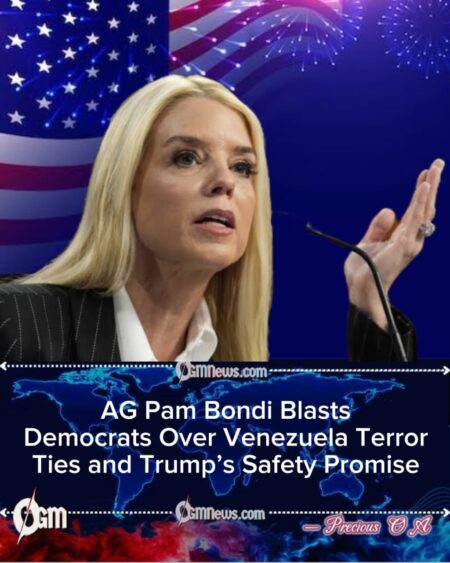
AG Pam Bondi issued a forceful public statement that immediately set off a new round of political debate in Washington, criticizing a group of Democratic lawmakers whom she accused of “standing in the wrong place” on matters related to Venezuela, transnational crime, and U.S. security interests. Her remarks referenced violent extremist networks operating in and around Venezuela, and she framed the issue as part of a broader dispute over how the United States should respond to foreign-based threats that affect Americans at home and abroad.
In her comments, Bondi emphasized that the dispute was not only about Venezuela’s internal politics, but also about what she described as a pattern of downplaying the danger posed by criminal and extremist groups linked to the Maduro government. She argued that any perceived tolerance of such actors undermines public trust in U.S. institutions and weakens America’s international posture.
Political analysts noted that Bondi’s language was unusually direct, reflecting heightened tensions as foreign policy, border security, and counterterrorism continue to feature prominently in national debate. Her statement quickly circulated across cable news, social media, and party fundraising channels, making it one of the most discussed political flashpoints of the week.
Context of the Dispute
The controversy centers on long-running U.S. concerns about criminal and extremist organizations operating in Venezuela and neighboring regions. Over the past decade, multiple administrations have accused the Maduro government of allowing illicit networks to function with limited restraint, sometimes pointing to alleged connections with armed groups involved in trafficking, kidnapping, and violent activity.
Members of Congress from both parties have repeatedly debated how to respond, weighing sanctions, diplomatic pressure, and international cooperation. While some lawmakers have advocated for aggressive measures, others have urged a more cautious approach that prioritizes humanitarian considerations and multilateral engagement.
Bondi’s comments brought these disagreements back into sharp focus. By framing the issue as a moral and security imperative, she placed pressure on Democratic leaders to clarify their positions and explain how their preferred policies would prevent harm to American citizens.
AG Pam Bondi and the Security Narrative
AG Pam Bondi also used her remarks to connect the Venezuela debate to President Donald Trump’s broader message about national safety. She referenced Trump’s campaign pledge to “make America safe again,” presenting it as a guiding principle that, in her view, should inform all foreign and domestic security policies.
According to Bondi, the administration’s posture toward Venezuela and similar regimes must be consistent with that promise. She argued that any political movement perceived as minimizing threats from extremist or criminal groups risks eroding the credibility of U.S. security commitments.
Supporters echoed her stance, saying her comments articulated a widely held concern among voters who prioritize border control, counterterrorism, and strong diplomatic pressure on governments accused of tolerating violent networks. Critics, however, questioned whether her rhetoric oversimplified complex international dynamics.
Political Reactions in Congress
Several Democratic lawmakers responded by rejecting Bondi’s characterization of their positions. They stated that they oppose terrorism and transnational crime, but differ on the most effective ways to address the situation in Venezuela, particularly when humanitarian conditions remain fragile.
Statements released by congressional offices emphasized that policy disagreements should not be interpreted as sympathy for violent actors. These lawmakers argued that targeted sanctions and diplomatic engagement, rather than sweeping rhetoric, are more likely to produce long-term stability in the region.
The exchange has intensified partisan lines on Capitol Hill. Political observers say it highlights how foreign policy disputes are increasingly woven into domestic political narratives, particularly as both parties seek to define their identities ahead of upcoming election cycles.
Public and Media Response
AG Pam Bondi’s remarks quickly became a focal point for political commentators and media outlets. Conservative talk shows largely praised her for what they described as “plain-spoken clarity,” while more centrist and liberal platforms questioned whether her framing risked inflaming tensions without advancing concrete policy solutions.
On social media, supporters shared clips of her statements as evidence of a tough stance on national security. Detractors countered with calls for more detailed proposals, arguing that strong language must be matched by measurable outcomes.
The online debate also revived older discussions about the effectiveness of sanctions and the humanitarian consequences of isolating Venezuela, illustrating how deeply polarized the issue remains.
Implications for Future Policy
Beyond the immediate controversy, Bondi’s comments may influence how security-related legislation is framed in the coming months. Lawmakers are currently reviewing proposals related to counterterrorism funding, border security, and international sanctions regimes.
If Bondi’s narrative gains traction, it could push Congress toward more assertive measures targeting regimes accused of tolerating extremist networks. Conversely, resistance from Democratic leaders could solidify alternative approaches centered on diplomacy and international coordination.
Either way, the episode underscores how debates over Venezuela are no longer confined to foreign policy committees but have become a broader symbol of competing visions for America’s role in the world and its internal security priorities.
Longer-Term Political Ramifications
AG Pam Bondi has positioned herself as a vocal defender of a security-first approach, aligning closely with Trump’s rhetoric and policy themes. Her role in this debate may enhance her profile among voters who prioritize law enforcement and national defense.
For Democrats, the challenge will be to articulate their positions in a way that balances humanitarian concerns with assurances of public safety. Failure to do so, analysts suggest, could leave room for opponents to frame them as weak on security.
As the political calendar advances, the exchange is likely to be referenced in campaign messaging, debates, and policy forums. It serves as a reminder that disputes over foreign threats, national safety, and presidential leadership remain central fault lines in American political life.
[…] […]