
























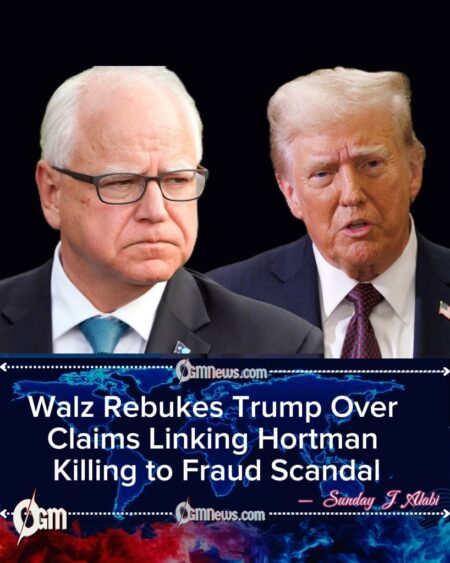
Minnesota Governor Tim Walz has strongly rebuked President Donald Trump, the current U.S. president serving a second term, after Trump shared claims linking the murder of Democratic lawmaker Melissa Hortman to a long-running Somali-linked fraud scandal in the state. Walz described the president Trump’s remarks as “dangerous” and “depraved,” arguing that they risk inflaming political tensions at a moment of profound grief for Minnesota.
Hortman, a former Minnesota House Speaker, was shot and killed alongside her husband, Mark, in a targeted attack over the summer. Authorities have maintained that the killings were politically motivated acts of violence, not the result of policy disputes or fraud exposure. The renewed controversy has reopened wounds for lawmakers, victims’ families, and a state still grappling with the consequences of extremist violence.
The President Trump’s Post and the Claims Circulated
On Saturday, President Trump reshared a post on his Truth Social platform suggesting that Hortman was murdered because of her vote related to eligibility for undocumented adults to access MinnesotaCare. The post implied that her actions were connected to a multi-billion-dollar fraud scheme allegedly involving undocumented immigrants, particularly members of Minnesota’s Somali community.
Trump also shared a video clip of Hortman speaking emotionally to reporters about her legislative decisions. The post quickly gained traction online, receiving more than 14,000 likes, and drew sharp criticism for appearing to attribute a motive to the killings that authorities have not supported.
Walz’s Response: “America Is Better Than This”
Governor Walz responded forcefully, calling the president Trump’s actions “dangerous, depraved behavior from the sitting president of the United States.” He warned that circulating unproven theories about a politically motivated killing risks encouraging further violence and undermining public trust.
Walz, who had worked closely with Hortman, said that suggesting alternative motives effectively “covers for an actual serial killer” and could put more innocent people at risk. He emphasized that Minnesota, and the country at large, must reject rhetoric that distorts facts surrounding political violence.
Lawmakers Across Minnesota Push Back
Democratic leaders across the state echoed Walz’s concerns. U.S. Representative Betty McCollum accused Trump of degrading the presidency by amplifying what she described as an “outrageous lie.” Minnesota House Democratic Leader Zack Stephenson noted Hortman’s reputation for candor and integrity, stating that any claim she was secretly involved in exposing fraud was untrue.
Even some Republican officials rejected the narrative. State Senator Julia Coleman publicly urged people to stop sharing what she labeled a conspiracy theory, stressing that investigators have found no link between the fraud cases and the assassinations. Coleman described Hortman as a committed public servant whose emotional public statements reflected the difficulty of governance, not fear or wrongdoing.
Voices of the Victims’ Families
Hortman’s children also condemned the president’s post. Her son, Collin Hortman, called on Trump to remove the video and apologize for spreading misinformation that he said dishonored his mother’s memory. Her daughter, Sophie Hortman, warned that the claims distorted her mother’s record and fueled political division during a time of mourning.
Yvette Hoffman, the wife of State Senator John Hoffman—who survived a shooting the same night—described the president Trump’s assertions as reckless and dangerous. She said such statements endangered families and compounded the trauma experienced by those targeted in the attacks.
The Broader Context: Violence, Fraud, and Accountability
Authorities have charged Vance Boelter with killing the Hortmans and shooting Senator John Hoffman and his wife. Investigators say Boelter maintained a list of dozens of intended targets, including liberal lawmakers and abortion providers, reinforcing the view that the crimes were rooted in extremist ideology rather than policy disagreements.
Separately, Minnesota has faced intense scrutiny over major fraud cases, including the Feeding Our Future scandal and alleged misuse of Medicaid and COVID-era loan funds. Federal investigators have pursued those cases aggressively, but officials have repeatedly stated that they are unrelated to the assassinations. Lawmakers from both parties have cautioned against conflating legitimate fraud investigations with acts of political violence.
A Test of Political Responsibility
The dispute highlights a broader national challenge: how leaders address tragedy in an era of polarized politics and rapid misinformation. For Minnesota, the priority remains honoring the victims, ensuring accountability through the justice system, and preventing rhetoric that could inflame further violence.
As investigations continue into both the shootings and the separate fraud cases, state leaders and families of the victims have called for restraint, accuracy, and empathy—principles they argue are essential to preserving public trust and democratic stability.
Casinoabc999? Good Site. The interface is sleek, and there is a lot of stuff to...