


























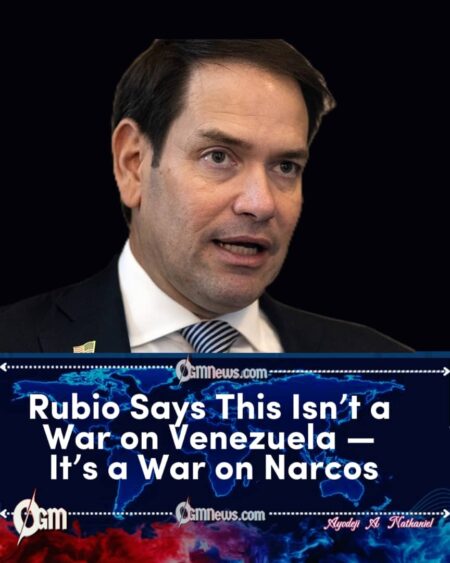
Marco Rubio has moved to clarify the United States’ posture toward Venezuela, asserting that Washington’s current conflict is directed at drug trafficking organizations rather than the Venezuelan nation itself. Speaking amid rising geopolitical tensions and domestic debate over U.S. foreign policy in Latin America, Rubio stressed that American actions are focused on transnational criminal networks that threaten U.S. security and public health, not on the Venezuelan people.
The statement comes as the administration of Donald Trump, now serving a second term, faces scrutiny over enforcement strategies in the region. Rubio’s remarks appear aimed at drawing a clear line between counter-narcotics operations and broader questions of regime change or military confrontation.
A Clear Distinction Between State and Criminal Networks
Marco Rubio emphasized that the United States views drug trafficking organizations as the primary adversary. According to the senator, these groups operate across borders, exploit weak institutions, and generate violence that destabilizes multiple countries while fueling addiction and crime inside the United States.
He argued that conflating criminal organizations with Venezuela as a sovereign state risks misrepresenting U.S. intentions. Rubio underscored that millions of Venezuelans are themselves victims of criminal violence, corruption, and economic collapse, and should not be treated as enemies.
The Role of Venezuela in the Drug Trade Debate
While distancing the U.S. position from a direct conflict with Venezuela, Marco Rubio acknowledged concerns about the role of state actors. He alleged that elements connected to the Venezuelan government have, at times, tolerated or enabled trafficking networks operating within or through the country.
These claims have long been a point of contention in Washington. Supporters of a tougher line argue that failing to address state complicity allows criminal organizations to flourish, while critics warn that such accusations can escalate tensions and undermine diplomatic solutions.
U.S. Strategy: Enforcement Over Invasion
U.S. officials have repeatedly described their approach as one centered on law enforcement and international cooperation. This includes sanctions, financial tracking, intelligence sharing, and joint operations with regional partners aimed at disrupting trafficking routes and cartel leadership.
Marco Rubio reinforced this framing, insisting that the strategy does not resemble conventional warfare between states. Instead, he characterized it as a sustained effort to dismantle criminal enterprises that profit from instability and corruption across Latin America.
Domestic Political and Legal Implications
Marco Rubio’s comments arrive as Congress debates funding for border security, counter-narcotics programs, and international partnerships. Lawmakers remain divided over how aggressively the U.S. should act abroad to address drug flows at home.
Some critics question whether expanded enforcement risks overreach or unintended consequences. Rubio countered that inaction carries its own costs, pointing to overdose deaths and organized crime as evidence that drug trafficking organizations pose a direct and ongoing threat to American communities.
Regional Stability and International Law
Analysts note that framing the issue as a fight against criminal organizations rather than a foreign government may help limit diplomatic fallout. Regional allies have generally supported cooperative counter-narcotics efforts while expressing caution about actions that could destabilize already fragile economies.
By emphasizing intent and scope,Marco Rubio sought to reassure both domestic and international audiences that U.S. policy remains bounded by law and focused on security rather than conquest or regime change.
What Comes Next
As U.S. engagement in Latin America continues to evolve, Marco Rubio’s statement highlights the administration’s effort to define its objectives narrowly. The challenge ahead will be maintaining that distinction in practice, particularly as enforcement actions intersect with broader political disputes involving Venezuela.
For policymakers, the debate now centers on whether the current strategy can effectively weaken drug trafficking organizations without drawing the United States into deeper regional conflicts.

[…] […]