
























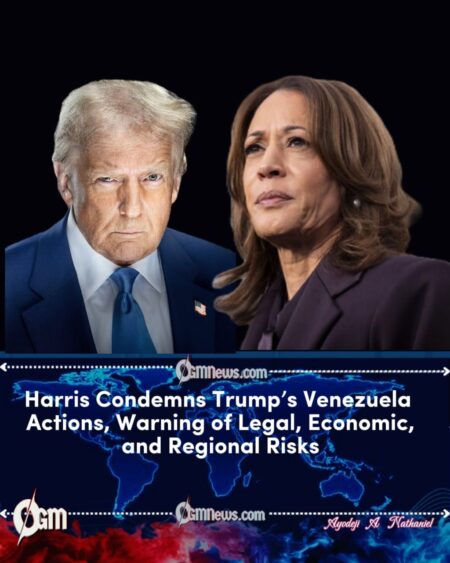
Kamala Harris has issued a sharply worded statement criticizing President Donald Trump over his administration’s actions and rhetoric concerning Venezuela. Harris argued that the approach does not enhance U.S. security or economic well-being and warned that it risks repeating past foreign policy mistakes that led to prolonged instability and domestic costs.
The statement represents one of the strongest rebukes from a senior U.S. official to date regarding the administration’s Venezuela posture, framing the issue as a test of legality, strategic judgment, and alignment with public priorities at home.
Harris’s Core Criticism of U.S. Policy
In her statement, Harris said that President Trump’s actions in Venezuela “do not make America safer, stronger, or more affordable.” While acknowledging that Venezuelan leader Nicolás Maduro is widely regarded as a brutal and illegitimate ruler, she argued that this assessment does not justify what she described as unlawful and unwise U.S. actions.
Harris emphasized that opposing an authoritarian government does not remove the obligation to act within legal and strategic constraints. She warned that bypassing these limits risks undermining U.S. credibility and weakening long-standing norms governing the use of power abroad.
Warnings Against Regime-Change Interventions
A central theme of Harris’s statement was a caution against wars aimed at regime change or resource control. She said the United States has “seen this movie before,” referring to past interventions that were promoted as demonstrations of strength but ultimately resulted in instability and long-term costs.
According to Harris, such actions often place the burden on American families through higher spending, prolonged military commitments, and regional chaos. She argued that historical experience should guide restraint and careful planning rather than escalation.
Claims of Oil-Driven Motives
Harris directly challenged the administration’s stated justifications, asserting that the Venezuela policy is “not about drugs or democracy” but about oil and what she characterized as President Trump’s desire to project regional dominance. She suggested that economic interests, rather than humanitarian or democratic concerns, are driving decision-making.
Harris further criticized what she described as contradictory behavior, including alleged engagement with individuals linked to the Maduro government while sidelining Venezuela’s recognized opposition. These actions, she said, undermined claims that the policy is designed to promote democratic transition.
Concerns Over Legal Authority and Military Risk
Another key element of Harris’s statement focused on the absence of clear legal authority and strategic planning. She warned that the administration is placing U.S. troops at risk, committing billions of dollars, and destabilizing a sensitive region without outlining an exit strategy.
Legal scholars note that questions surrounding authorization, scope of action, and congressional oversight often become central in debates over foreign intervention. Harris’s remarks echo broader concerns that unclear mandates can expose both service members and policymakers to long-term consequences.
Domestic Priorities and Alternative Vision
Harris concluded her statement by contrasting the administration’s Venezuela policy with what she described as the priorities of the American people. She said voters want leadership focused on lowering costs for working families, enforcing the rule of law, and strengthening alliances.
According to Harris, foreign policy should ultimately serve domestic stability and public trust. She argued that credibility abroad depends on responsible leadership at home and adherence to transparent, lawful decision-making.
Broader Political and Policy Implications
Harris’s remarks underscore growing divisions within U.S. leadership over the direction of foreign policy during President Trump’s second term. Analysts say the statement signals an effort to frame the Venezuela issue not only as a geopolitical challenge, but also as a matter of governance, accountability, and public consent.
As debate continues, observers expect increased scrutiny from Congress, allies, and international institutions. The controversy highlights how actions in Venezuela could shape both regional dynamics and domestic political discourse in the months ahead.
[…] […]