


























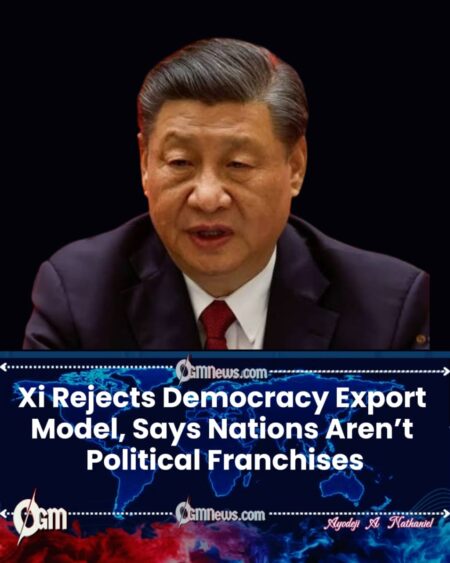
Chinese President Xi Jinping has offered a pointed articulation of Beijing’s view on democracy, arguing that democratic legitimacy should be determined by a country’s own people rather than by external judgment. In remarks addressing global governance and political systems, Xi emphasized that democracy does not follow a single template and warned against evaluating diverse political models through what he described as a narrow, uniform lens.
The comments reflect China’s long-standing position in international political discourse and arrive amid continued global debate over democratic norms, sovereignty, and the role of external pressure in shaping domestic political systems.
Democracy Defined by the People
At the center of Xi’s remarks was the assertion that democracy should be judged internally rather than imposed from outside. He stated that “whether a country is democratic should be judged by its people, not dictated by a handful of outsiders,” framing democratic legitimacy as a matter of popular consent within national borders.
This argument aligns with China’s broader emphasis on sovereignty and non-interference, principles it frequently advances in multilateral forums. Chinese officials argue that external evaluations of governance often reflect political bias rather than an objective understanding of local conditions.
Rejection of a Single Democratic Model
Xi further challenged the idea that democracy follows a universal structure, stating that “there is no fixed model of democracy; it manifests itself in many forms.” According to this view, political systems should be assessed in the context of each country’s history, culture, and stage of development.
Chinese policymakers often contrast this position with what they see as Western efforts to export a particular democratic framework. They argue that diversity in political systems is a natural outcome of differing national experiences rather than evidence of democratic deficiency.
Critique of Uniform Global Standards
In a broader critique, Xi warned against measuring political systems using what he described as a single yardstick. He argued that assessing “the myriad political systems in the world against a single yardstick” and viewing them “in monochrome” is itself undemocratic.
This language reflects a recurring theme in China’s diplomatic messaging: that global governance should accommodate plurality rather than enforce ideological conformity. Supporters of this position say it promotes mutual respect, while critics argue it risks diluting accountability for governance practices.
China’s Governance Narrative on the Global Stage
Xi’s remarks are consistent with China’s promotion of what it calls “whole-process people’s democracy,” a concept Beijing uses to describe its political system. Chinese officials maintain that public participation, consultation, and policy outcomes—rather than electoral competition alone—are key measures of democratic performance.
Through this narrative, China seeks to position itself as offering an alternative governance model, particularly to developing countries that may be skeptical of Western political prescriptions. This messaging has gained prominence as China expands its diplomatic and economic engagement worldwide.
International Reactions and Ongoing Debate
International responses to China’s democratic framing remain divided. Some governments and analysts agree that political systems should reflect local realities and caution against external imposition. Others argue that certain democratic principles—such as political pluralism and civil liberties—are universal and should not be relativized.
The debate underscores a deeper ideological divide over whether democracy is best understood as a set of shared global standards or a flexible concept shaped primarily by national context.
Implications for Global Governance
Xi’s comments highlight the growing contest over norms in international politics, particularly as emerging powers assert greater influence. As global institutions grapple with differing views on democracy and governance, questions about legitimacy, accountability, and sovereignty are likely to remain central.
Whether China’s perspective gains wider acceptance may depend on how effectively it resonates with other nations navigating their own political paths amid an increasingly multipolar world.


[…] […]