



























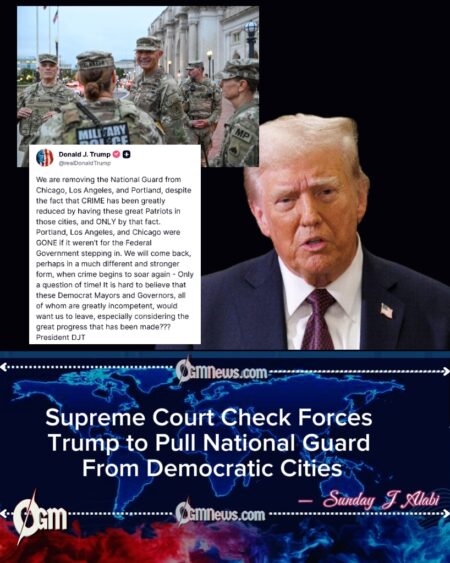
President Donald Trump, currently serving his second term in office, has ordered the withdrawal of National Guard troops from three Democratic-led cities—Chicago, Los Angeles, and Portland—following a rare Supreme Court ruling that went against his administration. The decision ends months of legal and political battles over the federal deployment of troops into states and cities that strongly opposed the move.
The President Trump announced the withdrawal on New Year’s Eve, praising the troops for what he described as measurable reductions in crime while sharply criticising local Democratic leaders for resisting the deployments. The pullout comes against a backdrop of declining national crime rates, heated debates over presidential authority, and renewed scrutiny of the Trump administration’s aggressive approach to immigration enforcement and public order.
Background to the National Guard Deployments
The Trump administration ordered National Guard troops into Chicago, Los Angeles, and Portland earlier in 2025, citing the need to protect Immigration and Customs Enforcement (ICE) agents during raids on undocumented migrants. The deployments followed violent protests and confrontations involving far-left activist groups opposed to federal immigration operations.
In addition to immigration enforcement, President Trump argued that the presence of the troops would contribute to broader crime reduction efforts, particularly in major urban centres struggling with violence and homelessness. Washington, DC, and Memphis were also cited by the administration as cities where troop deployments could help restore public safety.
Initial plans envisioned hundreds of troops in each of the three cities. However, legal challenges quickly limited or delayed their full deployment, with many soldiers placed on standby or partially withdrawn as court rulings restricted federal authority.
Supreme Court Ruling Forces Policy Shift
The withdrawal followed a Supreme Court decision on December 23 that refused to lift lower-court blocks on the deployment of National Guard troops in Chicago. That ruling effectively stalled similar cases involving Portland and Los Angeles, leaving the administration with limited legal options.
US District Judge April Perry in Illinois had ruled that the Trump administration failed to demonstrate a “danger of rebellion” or circumstances severe enough to justify federalising National Guard units. She initially blocked the deployment for two weeks before extending the order indefinitely while the Supreme Court reviewed the case.
While the Supreme Court has often sided with President Trump since his return to the White House, this ruling marked a notable exception. The court’s conservative majority declined to intervene, signalling limits to executive authority in domestic troop deployments.
Trump’s Response and Political Messaging
President Trump framed the withdrawal as a reluctant concession rather than a policy reversal. In a post on Truth Social, he praised the National Guard as “great Patriots” and claimed that crime had been “greatly reduced” solely because of their presence.
He also warned that federal forces could return “in a much different and stronger form” if crime rises again, accusing Democratic mayors and governors of incompetence for opposing the deployments. The President Trump argued that local resistance had undermined progress made by the troops on the ground.
The language underscored the deeply partisan nature of the issue, with the administration portraying the withdrawals as forced by hostile local governments rather than judicial constraint.
Crime Trends and Claims of Impact
The debate over the deployments unfolded amid a broader decline in violent crime across the United States in 2025. According to ABC News, homicides nationwide are expected to fall by roughly 20 percent—the largest single-year drop ever recorded.
Washington, DC, where approximately 2,000 National Guard troops were deployed beginning in August, recorded a 31 percent reduction in killings, the sharpest decline among major US cities. A CBS News analysis found that violent crime in the capital dropped by nearly 50 percent during the first 20 days of the deployment compared with the same period in 2024.
Critics, however, have questioned whether the declines can be directly attributed to troop deployments, noting that similar trends were observed in cities without National Guard involvement.
Legal Challenges Across Multiple States
Chicago was not the only city where courts blocked or limited the Trump administration’s plans. Similar legal challenges in California, Oregon, and Tennessee resulted in rulings against federal deployment of National Guard troops without clearer evidence of rebellion or insurrection.
In Illinois, Judge Perry wrote that she found no substantial evidence that protests against ICE operations had obstructed federal law enforcement to the degree claimed by the administration. Protests at the Broadview ICE facility near Chicago, while tense, were deemed insufficient to justify federalisation of the Guard.
Courts in other states echoed similar reasoning, reinforcing judicial resistance to the administration’s broad interpretation of presidential powers under domestic law.
Security Incidents and Escalating Debate
The controversy intensified after two National Guard soldiers were shot in Washington, DC, on November 26, less than a mile from the White House. One of the soldiers later died from his injuries, and an Afghan national who previously served alongside US forces has been charged with murder.
President Trump cited the attack as evidence of the need for continued troop deployments, arguing that the capital remained “crime-ravaged.” Democrats countered that the administration was placing soldiers in harm’s way for political purposes.
The incident deepened national debate over the role of the military in domestic law enforcement and the risks faced by service members deployed within US cities.
Implications for Presidential Authority
The Supreme Court’s decision represents a rare setback for the Trump administration, which has frequently relied on the court to advance its agenda. Since President Trump’s return to office, the court has allowed policies ranging from restrictions on transgender military service to sweeping immigration measures and cuts to congressionally approved spending.
Three justices—Samuel Alito, Clarence Thomas, and Neil Gorsuch—publicly dissented from the ruling. Alito and Thomas argued that the court lacked grounds to reject the administration’s claim that troops were needed to enforce immigration laws, while Gorsuch said he would have narrowly sided with the government.
Despite the dissent, the ruling underscores judicial limits on executive power, particularly in the sensitive area of domestic troop deployment.


Logging in is a breeze and the site stability is amazing even during peak hours....