





























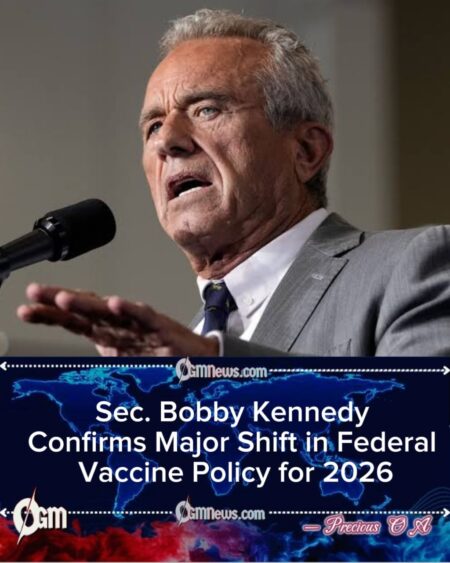
Sec. Bobby Kennedy confirmed this week that a major federal healthcare policy change is scheduled to take effect in 2026, stating that physicians will no longer face financial penalties when their patients decline recommended vaccines. The announcement represents a significant departure from long-standing reimbursement structures that have tied portions of provider compensation to immunization compliance benchmarks.
Sec. Bobby Kennedy said the change is designed to “restore trust in the doctor–patient relationship” and remove what he described as indirect coercion embedded within modern healthcare payment systems. The secretary argued that medical decisions should be grounded in informed consent rather than financial pressure.
The new guidance will instruct federal healthcare agencies to revise reimbursement models tied to Medicare, Medicaid, and certain federally backed insurance programs, removing performance deductions that have been triggered when patients opt out of specific vaccination schedules.
Background of the Policy Framework
Sec. Bobby Kennedy acknowledged that for years, federal performance metrics have included vaccination adherence as a quality-care indicator, linking physician reimbursement to population-level immunization data. These measures were initially designed to encourage public health compliance and prevent outbreaks of preventable diseases.
Under those systems, doctors in some programs could experience reduced incentive payments or quality-score penalties if their patient populations fell below federally established vaccination thresholds. Critics have long argued that this approach places physicians in a difficult ethical position.
Healthcare associations have repeatedly raised concerns that such policies blur the line between public health objectives and individualized medical judgment, particularly in cases involving patient hesitancy, allergies, religious considerations, or complex medical histories.
Reaction From Medical Professionals
Sec. Bobby Kennedy stated that the administration has received growing feedback from frontline providers who feel current reimbursement structures interfere with patient trust. He said many doctors believe that financial penalties undermine open conversations with patients who have concerns about vaccination.
Physician advocacy groups have welcomed the announcement, noting that removing penalty-based incentives may allow for more transparent dialogue and better individualized care planning.
Hospital administrators, however, are reviewing how the changes could affect broader public health targets, particularly in regions where vaccination rates have historically struggled to meet national benchmarks.
Public Health Considerations
Sec. Bobby Kennedy emphasized that the policy change does not signal opposition to vaccines, but rather a shift toward voluntary, informed participation. He said the government will continue funding vaccination access, education campaigns, and outbreak monitoring programs.
Public health officials are now tasked with adjusting strategy frameworks to rely less on compliance-based financial levers and more on community outreach, education, and accessibility initiatives.
Some epidemiologists have raised cautious concerns that eliminating penalties could impact vaccination rates if alternative engagement strategies are not sufficiently strengthened.
Legal and Regulatory Adjustments
Sec. Bobby Kennedy confirmed that federal agencies are already drafting new regulatory language to update provider participation agreements and quality reporting systems ahead of the 2026 rollout.
These changes will affect how physicians are evaluated under Medicare quality scoring programs and how incentive payments are calculated across several federally funded insurance plans.
Legal analysts say the regulatory revisions may also reduce administrative disputes related to compliance scoring and billing appeals.
Looking Ahead to Implementation
Sec. Bobby Kennedy said a phased implementation plan will be introduced, allowing healthcare systems time to adapt billing software, quality-reporting procedures, and provider education programs.
The Department of Health and Human Services plans to issue formal rule-making proposals later this year, followed by public comment periods and agency reviews.
Healthcare networks nationwide are now preparing internal policy updates, staff training initiatives, and patient communication strategies in anticipation of the shift.
Broader Policy Implications
Sec. Bobby Kennedy framed the move as part of a larger effort to reshape healthcare policy around patient autonomy and trust-based care models.
The change is expected to influence how insurers, hospitals, and private healthcare networks design future performance-based reimbursement structures.
As 2026 approaches, policymakers, physicians, and public health leaders will be closely watching how the new framework impacts vaccination participation, patient satisfaction, and provider-patient relationships across the United States.



Casinoabc999? Good Site. The interface is sleek, and there is a lot of stuff to...