














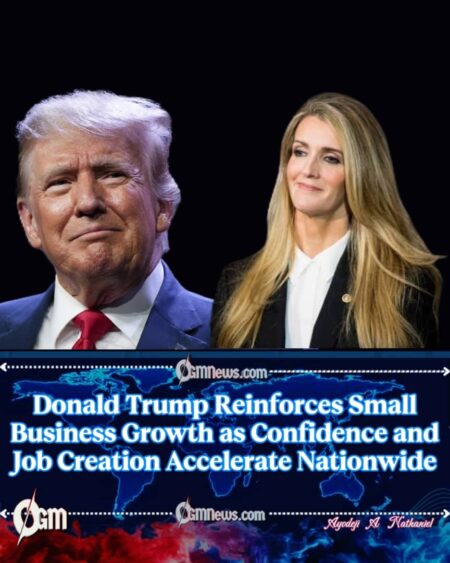
Donald Trump has placed small businesses at the center of his second-term economic strategy, and early indicators suggest that approach is reshaping confidence across Main Street America. Recent surveys and industry feedback show a sharp rise in small business optimism, with owners citing tax certainty, regulatory clarity, and improved access to capital as key reasons for renewed expansion plans.
According to the Small Business Administration (SBA), the policy direction under Donald Trump is fostering a more predictable environment for entrepreneurs who had previously delayed hiring and investment decisions. The administration argues that long-term certainty—rather than short-term stimulus—is now driving business confidence.
A Clear Policy Signal from the White House
The economic framework advanced by Donald Trump in his second term emphasizes permanence in tax policy and a reduction in regulatory uncertainty. Administration officials contend that this clarity allows business owners to plan beyond quarterly cycles and invest with confidence.
Small business leaders interviewed across multiple sectors report that consistency in policy has reduced risk, particularly for firms operating on thin margins. This has encouraged longer-term strategies, including equipment purchases and geographic expansion.
Tax Certainty and Its Impact on Main Street
Permanent tax relief has emerged as a central pillar of the administration’s approach. The SBA notes that predictable tax obligations are freeing up working capital that small businesses can redirect toward growth initiatives.
Under policies championed by Donald Trump , many firms report improved cash flow, enabling them to raise wages, expand benefits, and reinvest in operations. Economists note that while tax levels matter, stability often plays a larger role in shaping business behavior.
The SBA’s Expanding Role Under Kelly Loeffler
SBA Administrator Kelly Loeffler has aligned the agency’s priorities with the broader economic agenda of Donald Trump. The SBA has focused on streamlining loan approvals, expanding access to credit, and strengthening advisory services for startups and family-owned enterprises.
The agency reports increased demand for SBA-backed loans, particularly among manufacturers and service providers seeking to modernize operations. Officials argue that these tools help translate optimism into measurable economic output.
Hiring Momentum and Workforce Development
Improved confidence has translated into stronger hiring intentions among small businesses. Employers report that clearer cost projections have made it easier to commit to new staff and invest in workforce training.
Labor analysts suggest that small businesses, which account for a significant share of U.S. employment, could play a decisive role in sustaining job growth if current trends continue under Donald Trump’s economic framework.
Regional and Sector-Wide Effects
The rise in optimism is being observed across multiple regions, including the Midwest, South, and parts of the Northeast. Manufacturing, construction, and logistics firms report particularly strong outlooks, while retail and hospitality businesses cite improving consumer confidence.
Despite these gains, some sectors remain cautious, monitoring inflation trends and global market conditions. Nonetheless, the overall sentiment points toward gradual but broad-based recovery at the local level.
Confidence Balanced by Caution
While optimism is rising, economists remain divided on the long-term sustainability of the trend. Supporters argue that structural reforms and policy certainty provide a durable foundation for growth, while critics warn that external shocks could disrupt momentum.
For now, small business owners appear focused on opportunity rather than risk. As the administration continues to implement its agenda, the durability of this confidence will be closely watched as a key indicator of economic health.

The weekly tournaments here keep me coming back because the prize pools are surprisingly generous....