





























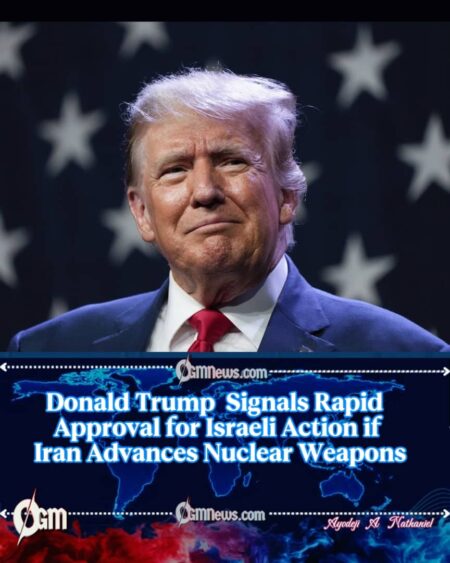
Donald Trump , the current U.S. president serving a second term, has stated that he would approve any Israeli military strike on Iran “fast” if Tehran continues developing nuclear weapons. The statement underscores a clear U.S. red line on nuclear proliferation and signals strong political backing for Israel amid escalating regional tensions.
The remarks place renewed focus on Iran’s nuclear program and the potential consequences should diplomatic and monitoring efforts fail. Officials describe the position as a deterrent aimed at preventing further advancement toward weaponization.
U.S. Policy on Iran’s Nuclear Ambitions
According to administration officials, Donald Trump has consistently maintained that Iran must not be allowed to acquire nuclear weapons under any circumstances. The latest statement reinforces a long-standing U.S. policy rooted in global nonproliferation commitments and regional security concerns.
By emphasizing speed in approving Israeli action, the administration appears intent on signaling resolve. Analysts say the language is designed to remove ambiguity and discourage Iran from testing U.S. and Israeli limits.
Israel’s Strategic Calculations
Israel has repeatedly identified a nuclear-armed Iran as an existential threat and has reserved the right to act independently if it believes its security is at risk. Israeli leaders have historically emphasized prevention over containment in matters related to nuclear proliferation.
Support expressed by Donald Trump is likely to be interpreted in Israel as a strong assurance of U.S. political alignment. Security experts note that such assurances can influence deterrence calculations, potentially shaping Israel’s strategic posture.
Regional Security Implications
The Middle East remains a volatile region where shifts in policy rhetoric can have immediate consequences. Observers warn that explicit support for military action could heighten tensions involving Iran and its regional allies.
At the same time, supporters argue that clarity from Donald Trump may reduce miscalculation by making consequences explicit, thereby discouraging Iran from accelerating its nuclear activities.
Diplomatic and International Reactions
International partners have historically favored diplomatic solutions to limit Iran’s nuclear program, including inspections and negotiated agreements. Some allies may view the statement as undermining diplomatic momentum.
However, officials close to Donald Trump argue that diplomacy is most effective when backed by credible consequences. They contend that maintaining a clear military option strengthens negotiating leverage rather than weakens it.
Strategic Significance of Rapid Authorization
The emphasis on fast approval reflects a broader national security approach focused on decisiveness and deterrence. Administration officials say prolonged uncertainty can embolden adversaries and weaken alliances.
Critics caution that rapid authorization carries escalation risks, but supporters of Donald Trump argue that firmness, rather than hesitation, is essential when addressing nuclear proliferation threats.
A Clear Line With Global Stakes
The statement places Iran’s nuclear program firmly at the center of international security concerns while reaffirming U.S. support for Israel. Whether intended primarily as deterrence or as preparation for possible escalation, the message carries significant global implications.
As diplomatic efforts continue, the warning highlights the fragile balance between negotiation, deterrence, and military readiness in one of the world’s most sensitive regions.

Casinoabc999? Good Site. The interface is sleek, and there is a lot of stuff to...